As an ’80s boomer, I missed out on the Pokémon craze, although I am tangentially aware of it, and like most normie folk, I can name at least a dozen or so pocket-monsters from the primary series. I don’t really know how to pronounce the word “Pokémon.” I say “pokey,” like an American philistine.
Jigglypuff is the anime-eyed ball of pink custard with the soporific voice. Its pronouns are “It/It.” The plural of “Jigglypuff” is “Jigglypuff.”
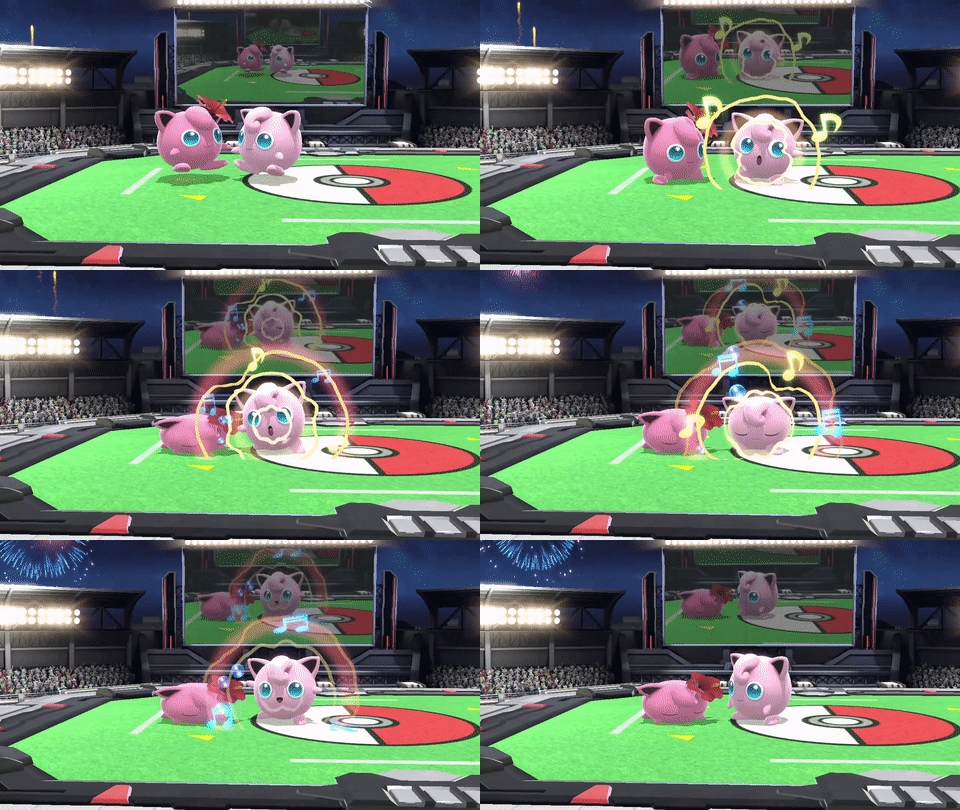
Relevant for this blog, Jiggly likes to sing. Its “Sing” attack is the trademark special move from Super Smash Bros. Soundwaves and noteheads shoot out of its body accompanied by this little melody, mic’d up of course. Jiggly is always mic’d.
Jigglypuff’s Sing is in the key of A Major. The short clip is taken from Jiggly’s full song, to which only sleeping ears may listen. It is transposed up a fifth from this version in D.
Pokémon was inspired by Japanese bug-fighting. There may also be an element of teaching demonology to kids. There is something about it that hypnotizes children. Who knows what Jigglypuff is up to while you sleep?
We made a Christmas album, unironically. Our last release from two years ago was a Christmas song. We’re basically an indie Christmas band at this point. We don’t have much else going on.
I like Christmas music with its bells, glocks, and idiophones galore. It sounds like Bruce Springstein’s E Street band has taken over the airwaves for a month. I don’t tune in every year, but it’s nice to know it’s there. I can listen to glock rock if I so choose.
I’ve wanted to make this little album for a few years, but it’s always chaotic to try to record it in December. Luckily, we started this in October and just barely made the yuletide deadline.
Los Doggies Christmas is 5-minutes-long and features lyrics not by me, but rather poetesses of the 19th, 20th, and 21st centuries. I prefer to write music, so I’m happy to have others write lyrics for me. Lyrics are usually the last thing I think about, and it’s always a strain to fit syllables to a melody (like writing poetry). This is how Sir Elton John wrote his tunes and it’s why he sang, “Pizza maaaan…melting all his cheese on pizza rolls.”
On this album, you’ll hear a secular song, a religious song, and a classic chestnut ballad. The first two contain lyrics written centuries ago now in the public domain. I tried to do these poems justice and make music that would sound pleasing to Victorian ears. The kind of music Mary and her immaculate baby could coo along with. Even the ox and lamb could tap out the rhythm in cloven beats. The Magi preferred prog polyrhythms in odd-times, so they’d go take a bowl break.
I’ve watched The Office a dozen or so times. I’m so old, I watched it when Netflix used to limit how many hours you could stream. (I only larp as an eccentric during the day. At night, I go full normie scumbag and watch TV.)
At the time, I thought The Office was the funniest show ever, and I wanted Jim and Pam to live happily ever after (like Zack and Kelly [and unlike Brandon and Kelly]). Now I’m cranky and bothered by all the cuckold triangles and overall degeneracy of American media. But if you haven’t seen it, you should probably go binge-watch the first 7 seasons. (You’ll have plenty of time during the upcoming lockdown to watch TV. Maybe we’ll go full fascist-Australia and be quarantined in a 5K radius. Maybe the vaxboots will go around door to door Santa-style and round everybody up and throw them in the covid camps for Christmas. We live in very exciting times!)
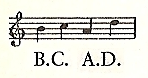
Anyway, the character Andy Bernard, who everybody hates, has a popular catch phrase, “Rit dit dit di doo,” which I have notated below. Who’s the normie now?
The catchphrase roughly follows the interval of a perfect fourth. It starts on a G and jumps down a fourth to a D. He rolls the R on the “Rit,” which I’ve always had trouble doing. I assume it’s genetic like tongue-rolling in general, and not that I suck.
Andy “the Nard Dog” is a music-lover who tries to be funny, but is really annoying and gets cuckolded instead. I wonder why some people find him so appealing. Probably his fashion sense.
While reviewing this blog and the animal music chronicled within its webpages, I discovered a glaring omission: I had yet to notate a donkey! How could I be so foolish to overlook one of the most iconic musical cries in the animal kingdom, the humble “hee-haw”?
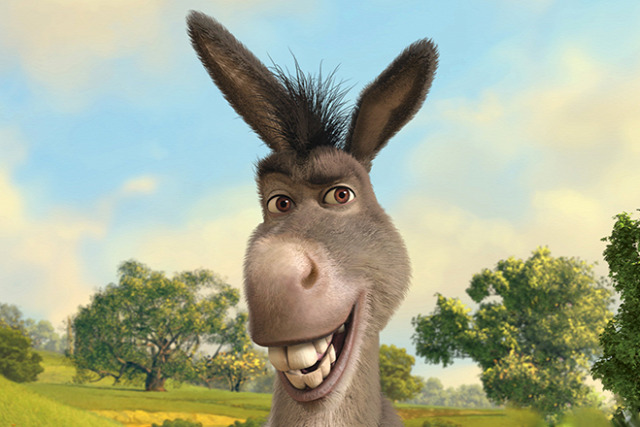
Donkeys are a cartoonish kind of horse. They are born with buck teeth and can be coaxed into any indecent act by means of a carrot tied to a stick. In lieu of a neigh, donkeys bray. Out of the six sounds of the donkey—growl, grunt, squeal, whuffle and snort—the bray is the most musical, and even that is questionable. Here is a donkey who hee-haws in an octave.
Not all donkeys bray in a perfect octave in C. This donkey is special. Bred for pedagogy. I’ve heard donkeys bray in all different intervals—dominant sevenths, major sixths, augmented ninths, you name it.
The above sound is taken from this video where an excited donkey brays at the sight of its owner. Donkeys bray for many reasons. They’re happy, or they’re sad. They’re hungry, or they got a bellyache. They’re glad to see you, or they hate your guts. You never know with a donkey.
Donkeys have long captured mankind’s imagination, probably because of the funny sound they make. Once considered on par with horses, donkeys have fallen from grace in modern times. I mean, they’re called an “ass” for God’s sake. When Shigeru Miyamoto needed to name his bungling ape boss, he opened a Thesaurus and chose “Donkey” for his “Kong.”
According to Bezo’s newspaper:
Donkeys have a bad reputation. They’re considered stupid, and stubborn, and lowly. All of which, says Fiona Marshall, an archaeologist at Washington University in St. Louis, is unfair and inaccurate.
“Whole trade routes were built on donkeys, and the wealth of ancient Egypt depended on them,” Marshall says of the sturdy horse relatives, which were once essential for moving goods around.
But over time, donkeys became animals for ordinary women.
Sancho rode a donkey, as did Jesus. Legends say the donkey got its cross on its back from shuttling the Lord to Jerusalem. In Ancient China, donkeys had good standing and the royals were buried with their asses. To this day, Chinese consider hee-hawing a sign of respect, so be sure to do so at the next Chinaman you meet!
Donkeys are also known to sing the blues.
Does this qualify as Lynchian? It has a donkey, a violin, and a small child, which is not quite a midget. I think to truly be considered 100% Lynchian, it needs to have a midget.
A screaming “kee-eeeee-arr” comes across the sky. It has happened before, but there is nothing to compare it to now.
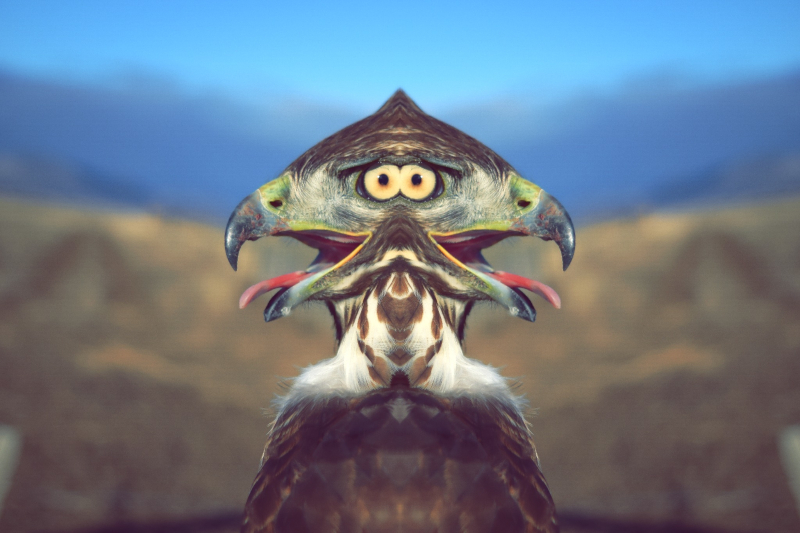
The red-tailed hawk makes a cliché call as it soars. You’ve heard it in movies in a million mountainside scenes, as a leitmotif for Natives, and a non-diegetic joke. It’s basically the Wilhelm scream for birds. Although in my neck of the woods, you really do hear it every time you step outside.
The “kee-eeeee-arr” is found in the highest soprano register near a G7 and bends down about a fourth. I believe Axl Rose can sing this note, because Axl is a red-tailed hawk. Castrati can also make a G7, but only when they stub their toe.
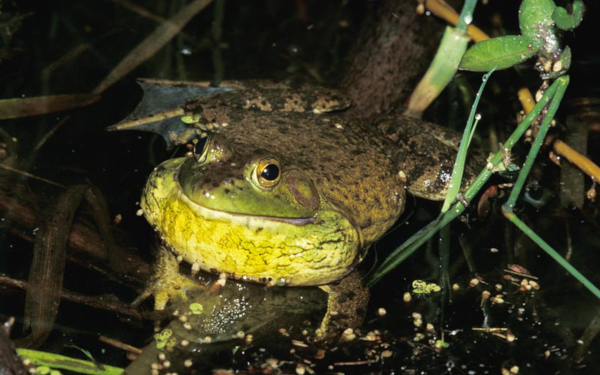
The bullfrog is so named for his bullish mating call, the “jug-o-rum.” Here’s how the bullfrog got his name: Long ago, some dandy fop was cycling his velocipede around a Northern pond, lost in transcendentalist musings, when he heard what sounded like a bull bellowing from the shallow end. The dandy fop shined his lantern over the source of the sound and was astonished to find a frog frozen in place, hypnotized by the light. Thusly he dubbed it the “bull-frog” and returned home posthaste to his Latin dictionary to think of a more lofty name.
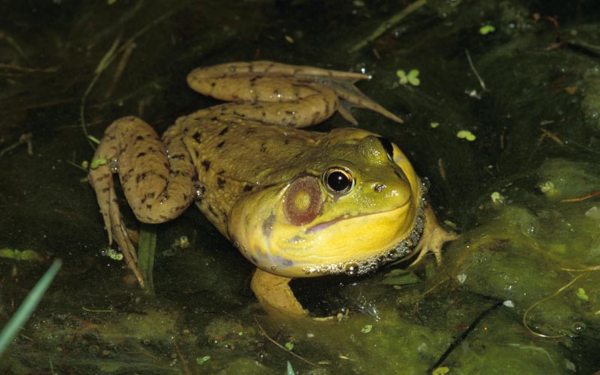
The bullfrog is a bit fatter than the green frog, but they look almost exactly the same save for the dorsolateral ridges on the latter’s back.
The bullfrog’s jug-o-rum is a deep, sexy, soulful call for mates like an Isaac Hayes song.
Scientists like to prank these guys by setting up speakers that play other male’s songs or placing frog mannequins in their way. We haven’t really learned much, but it’s fun to fuck around.
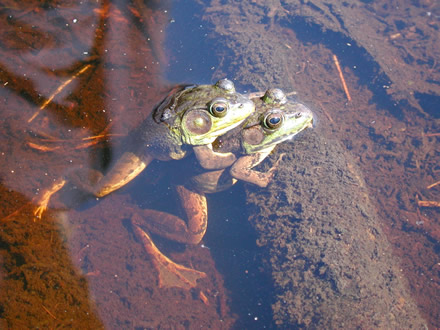
Two males will engage in combat over choice lily pads and whatnot. They get up right in each others craw, interlock hands, and wrestle with their forearms while they gronk and bonk at each other. It is a very froggy affair.
* * *
Paul McCartney once wrote a lovely little frog song called “The Frog Song.” I used to love this song as a kid—croaking bassline, psychedelic bridge, and epic finale wrapped up in a neat ork-pop package—and it still holds up. It was featured in a Rupert Bear cartoon, who is like the British Berenstein.
The green frog sounds like he’s mocking you. He calls out “GUNK! Gunk! Gunk!,” which is oft compared to a banjo twang, but he may as well be saying “Uh doy!”
This should really be notated in bass clef but I don’t want to confuse anyone anymore than usual. And I certainly don’t want any crusty bassists coming around here. It does sound like the first bar of a funky bassline though.
Choruses of these little guys will get together and host a sing-off to settle territorial disputes. It’s basically Battle Rap for frogs. There is nothing more civilized than men settling their differences with poetry and song. The War Department should immediately cease all operations and occupations at home and abroad, unless they can come up with a worthy Homeric verse.
Green frogs also scream like a girl when they get spooked and jump in the water. I would link a YouTube video, but most of them involve animal abuse. Instead just walk by a pond and let it happen.
Some say they’re turning the frogs gay. In reality, green frogs are naturally trans, but are increasingly genderfluid due to chemical pesticides. No analogy is being made here to Gen Z, so don’t you dare think it.
This site was constructed with Flash widgets which looked really cool, but then Adobe killed Flash and now parts of this page don't work. Nevertheless, Zombie Los Doggies Dot Com continues to walk the Earth.
RSS
Subscribe to our RSS feed and get 1-2 posts a week about life and music.