Skip to content

Duolingo: The Sound of Failure

In our last post, we covered the Duolingo “Sound of Success,” a happy Major Third inspired by door bells, store chimes, dial tones and car horns, which were in turn inspired by Big Ben’s bell song “Westminster Quarters.”

Now we turn our aural gaze to a more dissonant, evil sound—The Sound of Failure. If the Success Sound is designed to make you feel good by moving upwards in a happy interval, the Fail Sound is designed to open up the pit in your stomach and allow more room for sorrows and woes to swim inside your body and fill the emptiness that is you.

This interval from F# to C is known as a “Tritone,” a diminished Fifth or augmented Fourth. It takes the perfection of holy natural intervals and defiles them. The Tritone is the Devil himself appearing in music, or so they believed in the Dark Ages (back when you could openly beat a hunchback in the middle of the town square and nobody bat an eyelash.) Some middle-aged prudes in the Middle Ages (13-year-olds) even tried to ban the Tritone interval. It’s just that evil! And no Tritone is more evil than a Tritone in F-Sharp. It’s downright nasty.

If the Devil was Minister of Music in Heaven, got fired and fell down to Earth, it should follow that the Devil runs the terrestrial music biz as well. Take one look at the occult-laden sacred prostitutes of pop for proof.

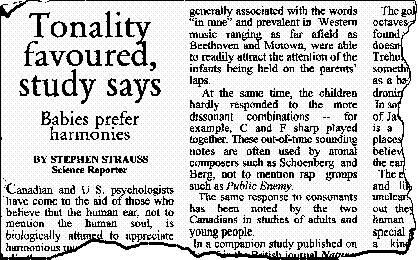
Scientific experiments with babies show that babies prefer Major Chords to Diminished Chords. That’s because babies are winners, and devils are total fucking losers.

For pedagogical reinforcement, the Major Third Success Sound and the Tritone Fail Sound were finely selected by the Duotrope Sound Design team. Unfortunately, all of these sounds are really fucking annoying. Instead of “Westminster Quarters,” we have “Westminster Every 5 Seconds.”

Duolingo: The Sound of Success

There’s a new Major Third in town. Move over church chimes and door bells. Eat your heart out, Big Ben. This new Major Third is nasty—it’s in F-Sharp!

The Duolingo sound for correct guesses is a pair of sixteenths notes from F# to A#—the happy part of a Major chord. A reverse door bell: the Duolingo sound goes “dong ding.” It’s supposed to make you feel good, the leitmotif to your dopamine hit. It helps you forget that the app is scanning your eyeballs, reading your mind, and selling the data to China.

All the Major Thirds around us go back to the song “Westminster Quarters.” Churches were always nice enough to put their chimes in a normal key like C Major, or sometimes E Major, but never something as nasty as F-Sharp. F-Sharp Major only exists because of 12-Tone Equal Temperament, the 20th century “Commie” tuning which is certainly the nastiest.

Compare the Duolingo sound to the coin sound in Super Mario Bros.

I hear the Duolingo sound about a thousand times a day after my girlfriend whispers sweet Italian nothings into her iPhone. It is the Pavlovian bell in our household. Since the phone never rings and the door bell never dings, we needed a replacement Major Third.

DiC Bumper

TV and film bumpers can pack a lot of music into a short window. They often run through multiple key changes in mere seconds. Cadences bleed into other cadences. Power choruses stacked upon lesser choruses. The TV bumper does all the work of a three-minute pop song in the course of fifteen seconds or less. Disney has a classic. The Fox fanfare is oft-missed.

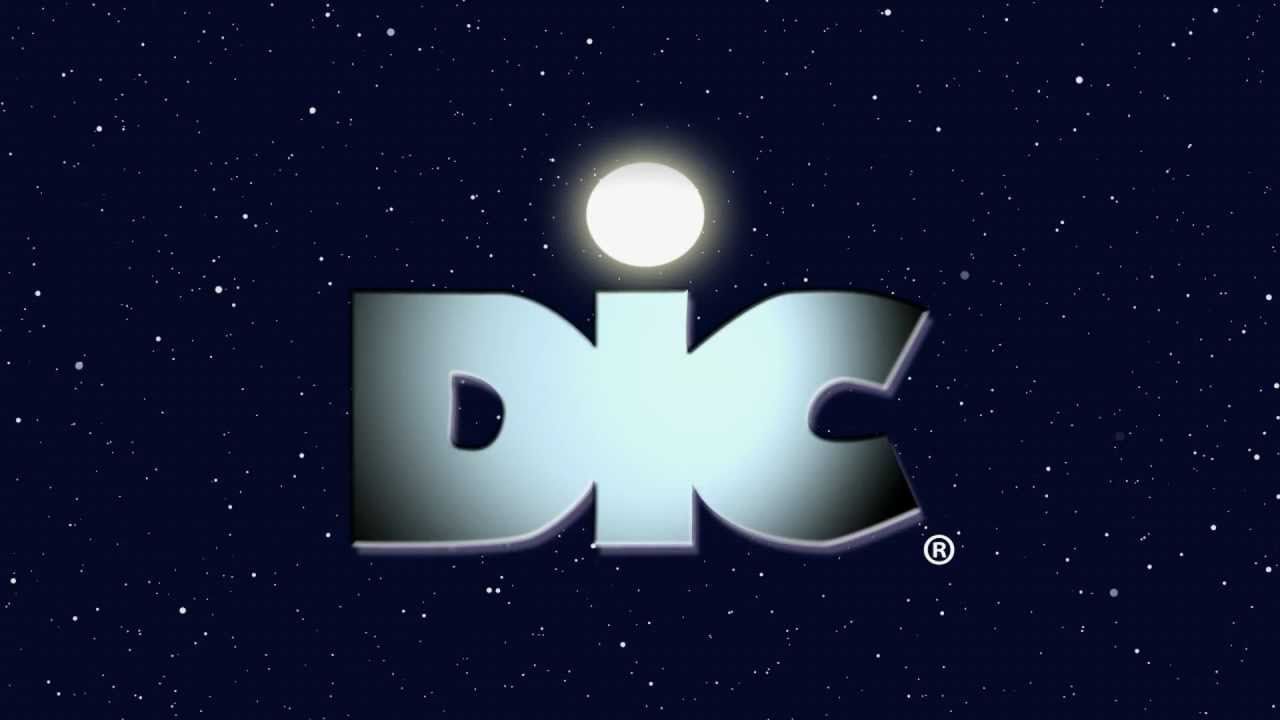
One popular bumper at the end of ’80s cartoon was for DiC Entertainment. A camera peers through a sleeping child’s bedroom, jumps out the window into outer space, where a star punctuates the “i” in DiC and a child’s voice pronounces the acronym as “deek,” although every single child everywhere subvocalized it as “dick.

It begins on a D9 chord, the V of G Major. Everything points to a perfect cadence to the G, but then they throw in a C (add 9), the IV. While still in the key of G, a plagal cadence is now expected from the IV to the I. Instead we get a bIII borrowed from G minor. The child intones the tonic “dic” on a G4, which is too perfect to be a coincidence. A musical director had to have cued the child, right? There would have to be an NBC chime on hand.

The withheld tonic appears in the voice with the name of the company. This is a stroke of genius subconscious advertising on the part of the DiC ad-wizards. If Beethoven were alive in the ’80s, this is the kind of thing he’d devote his musical brain to. Nobody ever realized what secrets the DiC bumper held until blog. Now that I know, one hundred neuralinked monkeys will also know, and soon the world.

The Diarrhea Song

Let us now reach back through the annals of time to recover a dirty little song that children used to sing to their bowels as they danced the Valsalva. This song was passed along in the great oral tradition from camp to camp, school to school, long before anyone would think about recording such a thing. It is known as “The Diarrhea Song.”

The movie Parenthood (1989) features a solid version of “The Diarrhea Song” sung by an annoying child. Luckily, the Mandela Effect didn’t erase this one. Here it is in the key of E Major. Either this kid has perfect pitch or the producer had a kazoo on hand to prompt him.

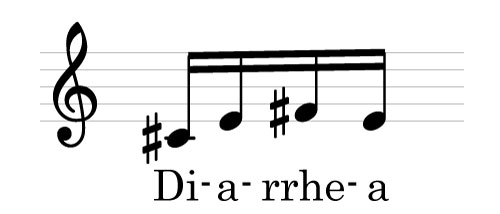
This same melody is probably a standard camp melody used for many different songs, based on some old American air, but it just feels so right to sing “diarrhea” in this manner, in a major pentatonic way. “Di, a, rrhe, a.” The 6 sidles up to the 1, turns to the 2 and turns immediately back to the 1. It sounds as inevitable as the act itself.

When you’re sliding into first
And your pants begin to burst
Diarrhea, diarrhea

When you’re sliding into two
And your pants are filled with goo
Diarrhea, diarrhea

When you’re sliding into third
And you feel a greasy turd
Diarrhea, diarrhea

When you’re sliding into home
And your pants are filled with foam
Diarrhea, diarrhea

Diarrhea, cha, cha, cha.

Lost Doggies

The long-awaited sequel to Dos Doggies is finally here.

Lost Doggies by Los Doggies, not to be confused with Los Doggies (2001) by Los Doggies, our first album. Dos Doggies (2002) was the sequel, and this is a kind of third one in a Godfather III sorta way. An album 20 years in the making that we stopped making 19 years ago. All of these lost songs were rescued from a scanned scrap of paper in an ancient email. A lot of them are about Nintendo. Some are offensive. Most are inappropriate. In keeping with the spirit of this zany trilogy of 18-song albums—Los Doggies, Dos Doggies, and now, Lost Doggies—we present these wrinkled old chestnuts in unadulterated form as a window into the past of the early aughts.

Air Horn

The Southern Oracle

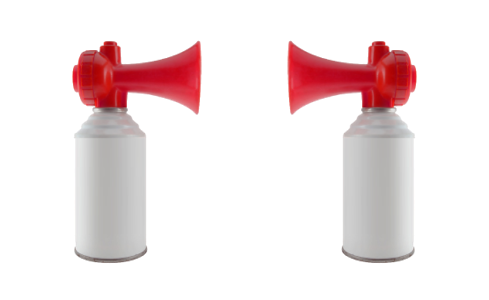
Before the government bans all manner of horns, let’s have a timely post on everybody’s favorite—the portable air horn. Like Pavlov’s bell, I’m pretty sure every living creature despises this cruel sound. More jump-scare than sound object. The loudness is definitely the most annoying aspect, but the portamento also plays a role in this handheld nuisance. The downward portamento especially has a mocking quality. It might not be so bad without the bend.

BEEEEEOOOOOOHHHHNNN. B-B-B-B-B-B-B-B-BEEEEOOOOOOOHHHHNNN. You can probably hear the air horn in your head just from my phonetic spelling, but just in case, here it is below.

Be sure to adjust your volume down and if you’re wearing earbuds, God save you!

The popular portable air horn begins around a G5 and slides down about a fourth to a D5.

Air horns have been widely used at sportball games. NHL uses the horn for a goal and UFC at the end of a round. It is a popular sample in reggae and hip hop. The Battle Rap league URL uses the sound to signify a fire bar, usually followed by a “Don Demarco.” The air horn basically adds hype to any situation. Hockey game, rap battle, Canadian border, you name it!

Jigglypuff Melody

Up Special Sing Attack

As an ’80s boomer, I missed out on the Pokémon craze, although I am tangentially aware of it, and like most normie folk, I can name at least a dozen or so pocket-monsters from the primary series. I don’t really know how to pronounce the word “Pokémon.” I say “pokey,” like an American philistine.

Jigglypuff is the anime-eyed ball of pink custard with the soporific voice. Its pronouns are “It/It.” The plural of “Jigglypuff” is “Jigglypuff.”

Relevant for this blog, Jiggly likes to sing. Its “Sing” attack is the trademark special move from Super Smash Bros. Soundwaves and noteheads shoot out of its body accompanied by this little melody, mic’d up of course. Jiggly is always mic’d.

Jigglypuff’s Sing is in the key of A Major. The short clip is taken from Jiggly’s full song, to which only sleeping ears may listen. It is transposed up a fifth from this version in D.

Pokémon was inspired by Japanese bug-fighting. There may also be an element of teaching demonology to kids. There is something about it that hypnotizes children. Who knows what Jigglypuff is up to while you sleep?

This image has an empty alt attribute; its file name is JigglypuffHeadSSBM.png
This image has an empty alt attribute; its file name is JigglypuffHeadSSBM.pngThis image has an empty alt attribute; its file name is JigglypuffHeadSSBM.pngThis image has an empty alt attribute; its file name is JigglypuffHeadSSBM.pngThis image has an empty alt attribute; its file name is JigglypuffHeadSSBM.pngThis image has an empty alt attribute; its file name is JigglypuffHeadSSBM.pngThis image has an empty alt attribute; its file name is JigglypuffHeadSSBM.pngThis image has an empty alt attribute; its file name is JigglypuffHeadSSBM.pngThis image has an empty alt attribute; its file name is JigglypuffHeadSSBM.pngThis image has an empty alt attribute; its file name is JigglypuffHeadSSBM.pngThis image has an empty alt attribute; its file name is JigglypuffHeadSSBM.pngThis image has an empty alt attribute; its file name is JigglypuffHeadSSBM.pngThis image has an empty alt attribute; its file name is JigglypuffHeadSSBM.pngThis image has an empty alt attribute; its file name is JigglypuffHeadSSBM.pngThis image has an empty alt attribute; its file name is JigglypuffHeadSSBM.pngThis image has an empty alt attribute; its file name is JigglypuffHeadSSBM.pngThis image has an empty alt attribute; its file name is JigglypuffHeadSSBM.pngThis image has an empty alt attribute; its file name is JigglypuffHeadSSBM.png