Skip to content

Music of the Spheres

At the atmosphere’s edge, where spiders, moments, gods, and all the other silent things live, the black noise―black as space, but golden as ever―travels on nothing to nowhere for light-years, like measures of rest that seem to last an entire score, it strips the babble off a baby, flattens wineglass song, and rips the screams out the maw of a dying animal, spreading uniformly forever, to its furthest reaches and depths, where here and there, the silence is greeted by giant humming rocks like hollow unstemmed noteheads, and singing stars that hum after death like posthumous box-sets, and the nervous noise of all sentient beings below, who rock themselves to death with death rattles and death growls, and rage, rage, rage with musical machines, against the dying of the light and sound.
In the distant Perseus cluster of galaxies, there is a black hole that emits a single note―a very low inaudible B-flat, 57 octaves below Middle C, with a frequency of 10 million years. While it’s true that space is a vacuum and for the most part your outer spacious screams would be as silent as God’s, there are stray bits of gas and dust that allow sound waves to travel. The gas around the Perseus cluster acts as a medium for the black hole’s sound waves to be measured.
  Drag over the B-flat on the left. If you hold the cursor in the center of the notehead, you’ll get sucked into the B-flat event horizon, which incidentally sounds like a Q Bass. If you move the cursor away from the notehead, the tone will decay, keeping the fabric of reality intact.

There are all sorts of hums out there in the heavens. The Earth makes a number of different hums―the Taos Hum and other regional drones that are only subjectively heard by certain people, the electromagnetic hum of the Schumann Resonance, the Electric Hum of Power Grids and other machines, and the chirps and whistles of the polar lights.


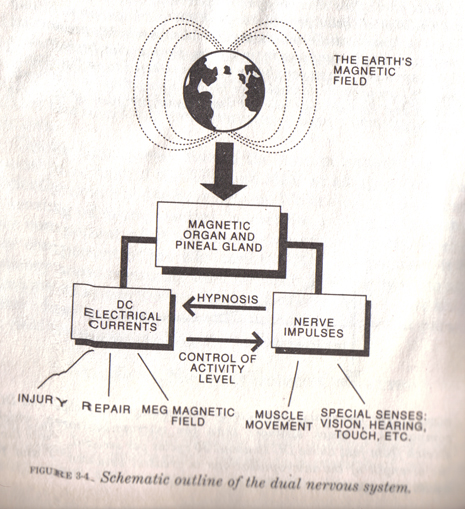
The Earth Tone is the keynote of our planet, except it isn’t a sound at all. It’s the pulsing of the Earth’s geomagnetic field. Lightning strikes in our atmosphere create standing waves in the extremely low frequency portion of the electromagnetic spectrum (the kind of phenomena you can see). This is the same band our electric brains use. The frequency spectrum of the Earth’s magnetic field is identical to that of other organism’s brains when viewed on an electroencephalograph. The fundamental mode of the Earth is around 7-10 Hz, which is in the alpha band of our brains―a calm, and restful state of minds, allowing escape from the usual beta bustle. When converted into sound, the Earth’s tonic is a low B, two octaves below bass clef, and nine ledger lines below the staff. If you had antennae for ears, this is what you would hear all day―a Great Farting rising up from the crust, and fizzling down from the firmament.


It works like this you see:

dual nervous system

It seems the Universe is heavy on the B-Tones, at least on our pale blue dot. Not only does the Earth hum a low B, but the eighth overtone of the Earth is around 60 Hz―the same frequency that hums from the North American Power Grid―and now this black hole on the other side of the Universe is also humming a flatted B. Why the bees even buzz sharp B’s, and maybe their third eyes are receiving Persian waves. I wouldn’t be surprised, if it turns out the cosmos are a large holographic bassoon blown by some crazy alien who keeps us bound to Concert B-flat.

So get out there and fuck the silence kids! It’s time to go a-caroling…
After all, it ’twas Jingle Bells that ’twas the first song played in space. They say the spheres still vibrate in sympathy with that dashing little song.
The Bleep

The motherfucking bleep tone is a high sharp B, and it sucks. Not even a real tone that you can tune to or anything, at 1000 Hz, it’s a quarter tone sharper than a B6, and as a single sine wave, sounds far more offensive than any profanity it masks. So fuck the bleep. Fuck it to death and fuck it back to life.

Holophonic Bug Love Songs

Everywhere are musical bugs, alighting on your ears like black unstemmed noteheads. They buzz like B-sharp bees, or dangle from ledger lines like silent spiders. They fly like flatted F# flies, and hiss like beetles. They crawl into your openings, like earwigs and brainworms, to sink their hooks into you.
They call to you in 1-note songs like crickets, then disappear every time you are near. It’s almost a 4/4 beat―keeping time like a heartbeat and other natural metronomes, sometimes approaching clockbeat click-track perfection if only for a measure, but usually tempoless and free like laundromat rhythms.

In a field of crickets, their staccato chirps smear together into one thick wavering drone. Imagine the male citizens of your country all singing together like this, in a field.

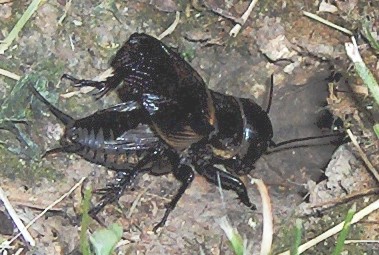
This is a field cricket who chirps in D, the kind I usually hear out my window. They play with their wings and hear with their legs. They dig amps into the Earth, all to impress the ladies.

Trill, rest, trill, rest, like Verse-Chorus-Verse. Each trill is perceived as a single tone, sometimes a D, sometimes flat or sharp. Sometime D natural straight-up. Concert D.

If we slow down their song 2 octaves, we can see each trill hovers around D and C#. Crickets fire off a quick burst of staccato wingtones and then rest for about the same amount of time, creating a pulsing beat.

If we slow it down yet another 2 octaves, we can see each single tone in the trill actually bends down from D to C#, and sometimes back up again. Plus, there are even smaller rests between these individual tones of the trill.

So not only is he hitting D’s and C#’s in lickety-quick trills, but he also bends each single tone between these two tones. There is a kind of holophonic [sic] principle at play here, whereby each tone contains the whole. While we hear a collection of single tones jumping up and down a half step, each perceived tone is made of many shorter tones that also jump up and down a half step, and finally, each of these shorter tones also bends up and down a half-step―a triple-tiered semitonal holophonic bug song of love.

Like any chirp tune enthusiast, I keep a cricket in a cage
Can I play.

Goonie Tunes


Sadly, there are no Cyndi Lauper widgets to be found here, although her syncopated breath and synth-drums carried many scenes of The Goonies (1985). Nor will David Grusin’s film score be featured, other then his false notation for One-Eyed Willie’s bone organ. No, this here has little to do with traditional music, for the most memorable Goonie Tune isn’t a tune at all per se, but it sure is a melody―an inadvertent movie melody that will go down in history with such classics as Mrs. Doubtfire‘s “Heeee-llo!” and A League of Their Own‘s “Has anyone seen my new red hat?”. Listen to Lotney belt it out below.


Sloth’s famous battle cry occupies the interval of a Whole Tone. Beginning on F# with the “Hey”, the melody bends down two steps to resolve on the E with the “Guys”. If we take his first note as the Root, and the latter as Dominant 7th, we can fit Sloth’s melody into the key of F# Mixolydian. The guitarist’s chord F#7(add11) will work nicely underneath the first and last tones of “Hey You Guys”. Try dragging over the chord above, and clicking the melody on in time.

When I remember this melody, it seems smaller than it actually is, and whenever I hear someone quoting it, it usually only covers a Half Tone interval. This melodic compression of our memories mirrors our natural development as an atonal-talking culture, whereby the giant intervallic leaps we once took as children, are squished and flatted out to a monotonous droning in our adulthood. As you can see and hear above, Sloth’s interval is huge, and can most accurately be transcribed into our 12-TET tuning as a Minor Third (Between the G and the E on “Guys”). Minor Thirds are big child-like intervals, found in Nana Nana Poo Poo and the like, but seldom appear in our conversational tones, except perhaps in flirtation and sarcasm. Sloth, is of course, protector of the children, and sole adult Goonie, though his deformity preserves his child-like mind, and his battle cry of love beseeches our melodic pasts. For more, read about the development of playground melodies.

Now, on to Willy’s bone organ.


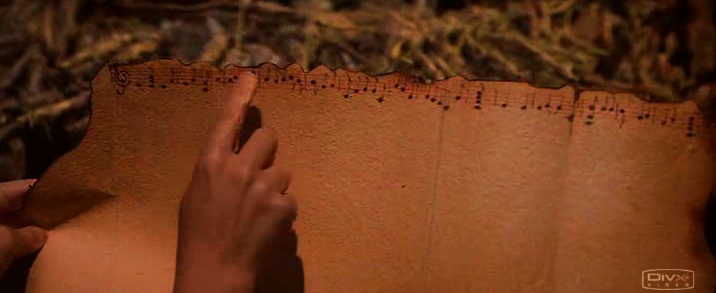
The Musical Death Trap scene above is full of flubs, perhaps to evoke Andy’s musical illiteracy. Then again, Willy’s score is preposterous (pictured atop) and looks like some simple C-Major piano exercises. Yeah right! We know Willy only gets down with Flatted Major Chords (and synth-drums). Drag over the chords below. Keep in mind, that Willy’s organ is a few cents flat, as is expected from shoddy Pirate Tuning. Arrrr…


Andy gets the first chord right―a Db Major, but she misses the B-flat Major twice. It sounds like she hits a Bb7(b9) instead, which is basically the same as a Bb Major except it includes a sharpened root up top. Andy nervously shouts “A-flat” right before she hits a B-flat Major. Was their some miscommunication on set, or did Spielberg meddle with this scene?


When Data bumps into Andy at the organ, he presses down on several adjacent keys creating a dissonant chord like at “???”, the kind of music cats like to play. Finally, Andy’s Fake-Out Chord that she denotes as “A, C#, and D”, is not actually played on the bone organ, but would sound like an incomplete D Major 7th. The Musical Death Trap resolves on a strong G Major. G is for Goonie.

Despite the growing popularity of death traps in modern cinema, there is a surprising lack of the musical variety. Most of our musical torture is reserved for animals (See the Cat Organ, see Catgut, see Every Musical Instrument’s ingredients). Even the Saw heptalogy failed to include one Musical Death Trap―a tom-tom drum stretched of human skin, or even an FAO Schwarz-sized Piano of Pain. I suppose, just being exposed to musical education in school, and these shitty little black noteheads like so many insects aswarm, was painful enough.

In closing, I would be remiss if I didn’t at least mention the Ballad of Jake Fratelli, affectionately known by fans as “Nim Bob Da”.


Ok. So what did we learn today?

1) Lauperian breathing is a lost musical device that desperately needs resurgence.
2) Sloth sings like you used to when you were a child.
3) Musical Death Traps are the best way to seek mastery in the tonal arts, so strap yourself in and play to the pain!

Super Mario Melodies

スーパーマリオブラザーズ
You and I, we live in a Netherworld of Noise. That’s why I’m taking you to Happy Tone Town. Everything that used to make noise, now makes a tone. Except blocks―they’re still noisey. But get this: Money sings! You can hear the coins klup into your pockets. And it’s logical too: Jumping makes a bendy tone. Time still exists though. And Death as well. But karma continues…

It’s the 25th Anniversary of Super Mario Bros. and so I’ll dedicate this lucky 71st Blog to Mister Miyamoto and Koji Kondo―my two favorite Nintendos―and the tonal world they created and continue to inspire. SMB 1 has a samba, jazz bass, a waltz, and the most recognizable first measure of any song in the world. Click on the score, paesano.

The famous “Ground Theme” begins with this cadence above, a turn-around, that resolves to the root. In this example, the secondary dominant D Major 9 moves to the dominant G, which ultimately resolves to the root, a C (not played). The Super Mario Trilogy is almost entirely in C Major. The sound effects in the game are also in key and made of quick arpeggios. Take the 1-Up for a roll.

This heavenly little arpeggio is a C Major (add 9) chord. It rises upwards like the 1-Up it accompanies. It twinkles like a newborn baby in your soul.

Another mushroom―the amanita muscaria―makes you larger. It’s a power-up with a powerful arpeggio that plows through three chords in a second.

The “Mushroom Power-up” is like the flag pole song condensed into a second. It’s not exactly the same but follows the same basic chord progression. The three chords Ab, Bb, and C, are also found in the bridge of the “Ground Theme”, (Duh, duh, duh, da, da, da, da, da, doh). The above example is in 4/4 to show how wacky the changes are in the Mushroom’s ascension. Krazy Koji Kondo changes.

And speaking of ascensions, here’s the jumpy sound. It’s got a Concert A attack, that leads into a lower A, that bends up to a much higher A. This kinda bend is known as “portamento”, what the Italians call a carriage.

Jumps are nice, and so are coins jumping into the air. Coins have an appoggiaturra on them. The appoggiaturra is a little note that jumps before another note in a melody. The appoggiatura in the example below helps create the “bling” sound.

The B acts as an ornament to the E. Together, they form an interval of a Perfect Fourth. In relation to C Major, the tonal center of Mario, they are a Major 7th and a Major 3rd respectively. What kind of world has Major Thirds erupting out of reality? Oh yeah, our world has that. Major Thirds are found in car horns, bells, telephones, door bells, convenience stores, pop music, and every other kind of music. And now coins.

Another Perfect Fourth is found in the “Kill” sound. It’s got a certain air of frogginess to it, like frog mario, but this sound, is no mating call; it’s a death rattle. I fear what our world would become, if killing were as tonal as this:

The Perfect 4th in the “Kill Sound” is between the C and the F, a semitone above the “Coin Sound”. While the Coin 4th was intended to harmonize with “Ground Theme” and the C-Major tonalities of other Stages by providing a Major Third (and Maj.7th), the Kill 4th is much more dissonant by asserting it’s own tonic―the F, over the C-Major Ground.

You see, Fourths and Ones are always competing with each other, because of their likeness (just 1 tone difference). They each assert themselves as tonics, trying to usurp each others scales and make them their own. So much harmonic progression consists of this Battle between the I and IV (See the Blues, see Hymns, see Everything on the Radio Ever). Throw a V in there, and you just about summed up all Music.

So if we return to the game for a second and allow the musical metaphor to play out, it goes like this: The World is in C Major―a happy tonality that even babies like. Your Sprite also loves C Major, for his dear power-ups make harmonious tones when ingested. Other Sprites have their own tonics, that sound dissonances when they die. Analogously, our World hums in B-Flat. The Electric Tonic of the Earth is also a B. Our electric minds also resonate with the Earth at around the same frequency. Though our deaths seem dissonant if we selfishly try to isolate our tonics from the Tonic of the World, they actually adhere to a higher-order Tonality that sounds from all things―clouds to bushes―and knows no dissonances. And oh yeah, Mister Miyamoto is also a God here.

Last, but not least: the humble fireball. The fireball is a quick glissando that burns through three G tones. The staccato G-fireball is dominant and perfect fifth to the C root of the game.

Now back to your Netherworld where the Noise stalks your every step, and the most tonal things around are the bugs and birds―ya know, baddies?

Mystic’s Chord

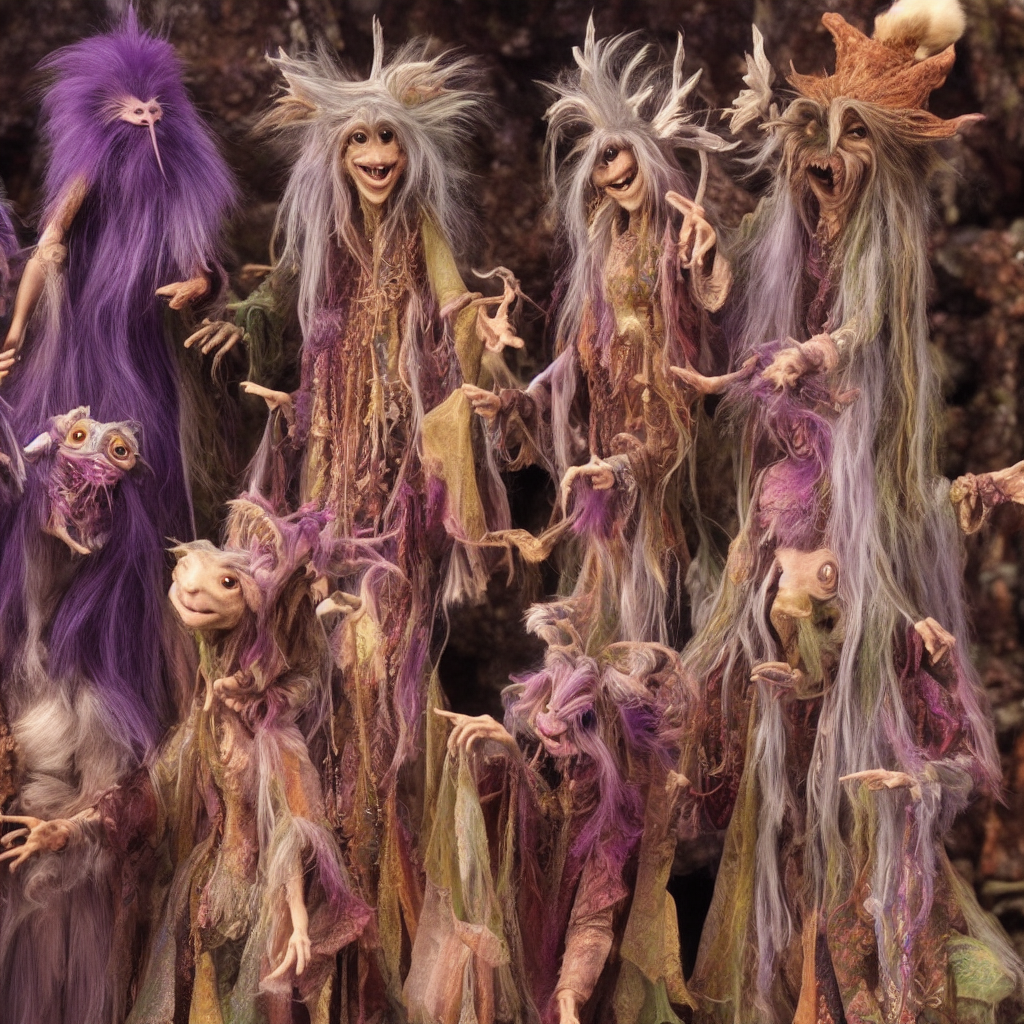
Jim Henson’s 1982 puppet epic The Dark Crystal features a race of gentle beings known as Mystics. Central to the lives of the Mystics are a series of musical rituals, the dissonance of which, seriously belies the gentle nature of these fraggle-faced hunchbacks. Behold the Mystic’s Chord!

What a chord! It’s like three chords in one! This reminds me of the way religion used to scare me as a child (or how this movie use to scare me). The Mystics sing an octochord, each sustaining a single tone to form a chord made up of 8 unique tones, and yet this mantric auming doesn’t fit into any clear-cut tonality. No, this octochord is modernist all the way―a kind of serial tone row that suggests many tonalities. It begins seemingly in the scale of B Harmonic Minor, the first tones of which form a B Minor Augmented 7th, but soon changes to a C Augmented formation, which further muddies the harmonic structure, until it resolves on a strong G# Power Chord. Click on the play button, drag over the noteheads, or push the square button for a musical analysis.

If we arrange the tones in order, they form a very interesting synthetic scale. How does one make a synthetic scale? Well, take an ordinary B Minor Scale and add accidentals (sharps and flats) wherever you feel like (except the root), and you’ll come out with something suggestive of B-like Tonality, except with a completely novel tonal character.

The Mystic’s Scale is like a B Minor Scale, with the 2nd and 4th are flatted, and the 6th and 7th sharped. This creates a chromatic environment surrounding the root, with the 7th and the 2nd only a semitone away. This kind of dissonance is the essence of a ‘synthetic scalar’ sound, for they are not found in the popular major/minor modes. It is the chromatics, the major/minor ambiguity, that make the Mystic Scale highly dissonant and other-sounding.

There is another popular Mystic Chord used by Russian composer Alexander Scriabin. This chord is similar to the Mystic’s Chord, in that it features many unrelated chord’s stacked atop one another. The dissonances inherent in synthetic scales are mitigated by sounding adjacent tones in different octaves.

It has been said that “a chord is a melody stretched to the size of a moment”.

Indeed, a melody is a chord that’s been unraveled from within.

For Jupiter’s sake, how did musicians ever invoke the mystical before Standard Tuning when Synthetic Scales were born, incubating in their cradles for a 100 years to be rocked!

The Billy Dee Wilhelm Scream

The “Wilhelm Scream” is a popular Hollywood stock sound. Originally recorded for Warner Bros. Westerns, the scream achieved cult status with its appearance in the Star Wars and Indiana Jones trilogies and continues to be used extensively today.

Here is the Wilhelm 4―the most classic of the Wilhelms.

There is a lesser known sister satellite scream―the “Billy Dee Wilhelm Scream”. This soundbite is heard in the same scene as the Wilhelm from Return of the Jedi, but it is no stock sound, for this scream is issued from the lips of actor Billy Dee Williams.

Where as the Wilhelm is more of a classic “Ahhhhh” kinda scream, the Billy Dee Wilhelm is like an “Eeeeeyaaaah” which contains all the Wilhelmic horror, mixed with a little soulful disgust.

It sounds like Billy Dee was really going for something—the all-new stock screambite monopoly. That’ll be the day, when Wilhelm becomes Williams.

Ya freakin’ pirate…