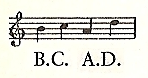
The popular Car Arm Alarm is a duplet of flat B’s that bend upwards. Within this short mechanical musical phrase, one can hear the ten thousand voices of nature crying out for an audience. Like the quick stridulation of an insect or the glissando of a bird, the Car Arm Alarm is followed by long rests that carry great moral weight. Like the clucks and bwoks of a chicken, it seems to speak in onomatopoeia (What’s it sayin?). Like the “klup, klup” of Mario’s fireball, or the “pew, pew” of a lazer gun, it travels on for great distances, bouncing off walls, and over hills.
Perhaps, this little phrase is man’s own “proprietorial call”, fashioned after the territorial songs of animals who’ve everything to lose. Drag over the noteheads below, from left to right, to listen to the Car Arm Alarm, or click on the image to view the Car Arm Alarm Waveform.
Each “chwup” begins on a flat B (about halfway between a B and a Bb, like the Grid Hum), and then bends upwards. The first tone doesn’t bend as high, and only reaches around a C, while the second goes to a D. The whole thing sounds like a whole tone interval (C to D) because of how quickly each note bends.
The Car Arm Alarm may have originally been inspired by bird calls, but in turn, it has inspired new bird calls of its own. Lyre birds and mockingbirds are known to imitate the Car Arm Alarm among other man-made sounds. It’s starting to get confusing out here in the jungle, as I often mistake the hum of a street light for a hive of bees, car alarms for the calls of birds, and hallucinate ringtones arpeggiating out from silent buttocks.
Epilogue:
Hmm, maybe it should be Car Alarm Arm? Either way, three times fast is two too many fast.
Real men know how to end a song. They don’t play chicken at the chorus, so why wimp out in the final bars? Real men kill their songs with their bare hands, like babies crying in their cribs far past bed time. Songs are the sons of men—prodigal, oedipal—and they’ll kill their composer daddies unless he kills them first. Real men hit it, then quit it, but they ain’t no quitters.
Real men die as they dream—fabulous.
There are ways around it. You can fade out, nice and gradually, as if passing on in the middle of the night, unconscious of the dying that envelops you. You can fade, and let the attack of life peacefully decay into the black noise of death.
Maybe it doesn’t have to end at all? You can just cross-fade into another incarnation; reborn in endless playlists of birth and death. The friendly voice of the deejay deity will come on the aether and lull you into this or that form. Maybe you could just put yourself on repeat, and forever loop the memories and melodies of your youth.
Songs today rarely need to stand alone anyway. They segue endlessly into the next in a sea of songs, like billions of babies booming each year. There’s plenty of bodies to possess. Let the masses cling to their genres, and live out their plasticine days in easy-listening limbo.
We just wish the good songs never had to end, especially this one, ’cause it’s so good. But the good songs are ending all the time, right when they begin playing, and they wouldn’t even be good without the ending. All sounds return to the silence, as all souls return to the source.
The root of all existence is you, tonic friend and birthnote. Drag over that C4 below and simply observe how all things return to nothing.
The most popular key in pop and pedagogy is the C Major scale. These seven sacred tones relate to the colors of the rainbow. Drag over the C Major Scale below.
The drama of music results from the tension between the tonic and the rest of the key, much like the drama of life results from the interactions between the self and the rest of the world. Musical cadences create the perception that a song has a central tone around which all other tones revolve. Cadences are happening all the time in music, in every measure, everywhere. They are the endless ending of musical phrases, jumping up and falling back onto itself.
There are two main cadences used in popular music. The first is the Plagal cadence, or the “Amen cadence”.
This is how choir boys kill their tunes, not men. The plagal cadence is kinda weak because the tonic never really goes anywhere. The C tone root is found in the cadential chord, and so it doesn’t get to leave home, and return to die. It’s like it kills itself for never leaving home. It’s no “Authentic Cadence”.
Yes, goddamn. That is how real men meet their end. The authentic cadence is the perfect cadence—the killing cadence. It kills itself with its own hands. It’s a painful and satisfying conclusion to this crazy song we call life.
A certain corporate jingle capitalizes on the authentic cadence.
“By Mennen”, the popular 90’s commercial melody, is by far the most insidious jingle ever written. It’s far worse than the NBC chime, which uses the same cadence. They took the most basic phrase of music and set those ridiculous lyrics to it. “♫ Byyyyy ♫ Mennen ♫”
Mennen: It’s not even a palindrome. Some earworms never crawl out of your brain. They can’t be killed as they copy and share themselves when split.
Who knows what Mennen is and what it advertises for? No one remembers. The melody will live on, long after the company it sang for is just a memory.
“By Mennen” harks back to another manly cadence, the memorable “Men – Men – Men” cadence from “Stout Hearted Men”. In the key of F,
Above is the choir version. I don’t know much about endings, but that’s a great way to begin a song.
Epilogue:
Now how will we die sweet friends? Die like a dominant? Will we fade out slowly into the night like “Hey Judey Judey Jude”? Or will we hit and quit it, kick it and kill it, like men.
One little note can cost you the game, the respect of your fans, and the love of your teammates.
One little note can kill your career and break your band up into smithereens.
What a huge difference one little note can make! The difference between heaven and hell lies in a mere semitone. A half-step between public praise and hater’s hate. One hundred cents between consonant triumph and dissonant failure.
One little note can bring on the scorn of a nation. Even in a song that nobody likes—a schmaltzy waltz that is about as embarrassing to sit through as Happy Birthday.
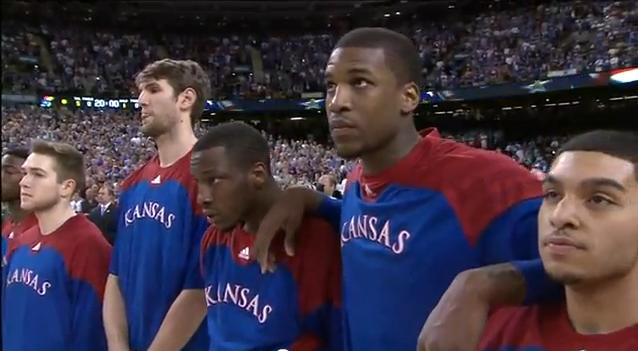
All of the public criticism for “The Star-Spangled Banner” by pop group The Fray at the NCAA championship a couple days ago1 hangs on one little wrong note, though you won’t hear about it in the news.
Now that’s just mean. I guess the emo thing is somewhat accurate, referring to the two distinct acoustic guitar parts and uh, emotional singing, but why no mention of the obvious wrong note on every third chord? It seems people don’t trust their ears when they hear dissonance. It happens to the best of us.
There’s no way people hate this version for stylistic reasons. It can’t be because they played it as a schmaltzy waltz. “The Star-Spangled Banner” is a schmaltzy waltz!
It can’t be because they made it a “One Five Four Five” Chord progression; everyone loves those!
It might be because the instrumentation was a tad too “Occupy” for people’s tastes, but it’s actually a pretty conservative folk arrangement, and not at all the main reason for the jingoistic indignation stirred up in the public. Guitars, dudes, a tambourine, and a drum—it’s pretty damn all-American. This easily could’ve been the version George W. Washington sang at the end of the Civil War.
No, it’s got nothing to do with politics. It’s because of one terrible horrible no good very bad little note as demonstrated in the two widgets below.
The rhythm guitarist plays the I V IV V chord progression in G.
However, the other guitarist hits a high G# over the C Major Chord, instead of a G. At just a semitone away, the sharpened tonic is one of the most dissonant possible wrong notes they could’ve played.
Try dragging over both guitar parts simultaneously in alternating up and down-strokes. Just drag over the start of each measure, then slowly move on to the next pair to get a taste of the delicious dissonance lurking in the cliché chord progression.
The sad part is that the guitarist plays it right in the intro (with the G), and then botches it for the rest of the song (with the G#). Or maybe they were going for something truly progressive?
The whole mess creates a very silly harmony, an unintentional augmented chord—C Major with an added Minor Six (Ab). It’s a musical joke of sorts, and that’s one thing Los Doggies can get behind.
The guitarist responsible for this hilarious Easter egg in our anthem, tweeted in response to the criticism:
“Upon thinking about it, doing the National Anthem is a bit like choosing between Jif and Skippy. You just can’t please everyone.”
So true! Who could possibly understand the subtleties of such a dark dissonant musical joke such as the sharpened G in a G major love song to your country? What followers will catch the tonal depravity involved in unapologetically disgracing the old forms like that? What compatriots will embrace the musical irony—intentional or not—spread it around evenly, and then put it back on the shelf like nothing ever happened?
I can relate though. When you’re on stage, your mind can play tricks on you; mess you up. Take a look on the youtube below. A clear case of musical madness caught on camera.
Notes:
[1] It starts off tonally enough. G Major certainly is a fine key. The first instrumental 8 bars are fine, but it sure takes a sharp turn for the worse in the 11th measure when the guitarist starts hitting the G#, and continues to hit it for the duration of the song. However, if this didn’t have that fuck-up, and had beautiful tertian harmony throughout, with the right chord progression, or fuck it, even just two chords, this would be a lot of people’s favorite anthem rendition, probably even win them a Grammy, instead of being the Barr-mangled banner it is, all because of one little note.
Spring has sung, and the birds are back. And not just the songbirds either, but naughty little fuckbirds1 too. Black-Capped-Fuckadees that go fuck-a-dee-dee-dee2. Songless Woodfuckers3 who can only drum out their love. Bluefucks and yellow-tailed whippoorfucks. Perhaps they are speaking the divine dirty ‘language of the birds’. Or just letting their harmonic throats do the squawking. Zoomusicologists will contend the latter. But they don’t know why the caged bird sings! Who knows why the caged bird4 sings?
I know why,
So, occasionally this blog is relevant—like really relevant. Topical too. Like when a new fictional bird is introduced to the public consciousness, and within the fortnight, the relevant bloggy and widgets are up and running.
Below is a short yet striking scene from The Hunger Games (2012). I’m pretty sure it’s the climax of the movie. No spoilers. Click on the youtube to play it.
/
The mockingjays aren’t very tonally reliable. Not like my singing telegram guy. These birds change the key on you. Maybe it’s just the dopplers shifting around while they fly and sing at the same time, or maybe they purposefully mock the melodies of the humans below them. And why not? Just at look at what these girls melodisize as their distress call and answer!
The first girl begins singing a D Major scale, rising up in thirds from D to E. However, the second girl sings in G Minor, and instead falls down on the final note, resolving to a D, the initial tone. It has a kind of fearful symmetry you see. Each four-note melody has two notes in common (G and D), that mirror each other at the beginnings and ends of the melodies. Both melodies fit nicely into the key of G Melodic Minor (G A Bb C D E F# G).
The second melody acts like a reverse picardy5. Instead of resolving to the G Major as was expected, the bird call picardies to a G Minor, subtly setting the viewer up for tragedy, sweet glorious tragedy, that lifts one up and drops one down like the dirty little fuckbirds that ferry our births and peck us unto death.
Oh, and Happy Harry Hundos! This here blog is an hundred blogs old.
[4] The Musical Cryptogram “CAGED B” resembles the locrian scale, the 7th mode of C major, but really it’s a scale all its own. Also of note, the cryptogram spans greater than an octave, starting on a C and descending down a C Major Pentatonic scale, only to resolve to a B, defiantly passing over the root, as is to be expected from caged birds, a game of melodic leapfrog (similar to musical chairs), that tinges the modal mood with just the right amount of longing, sweet longing to be free from the tonic king.
New York New Yorkers have been singing lots of fresh new songs over the past couple of months. They sing on the street, and in the park, and on the bridge. They even engage in what George Orwell once called “group-sing”. They sing syncopated 4/4 call-and-answer crowd-pleasers, sung with the People’s Microphone, at plus 120 beats per minute, many of them throwbacks to the 60’s anti-war folk era. That old standby “Hey Hey, Ho Ho”, while explicitly unsung throughout the movement, inspires many of the cadences you hear in modern day protest music. “The People United” as widgetized below, has the same feel as this revolutionary classic. To sing it is to realize a tambourine is never far behind.
The iambic rhythms of the “hey-HEY” and the “ho-HO” are kept intact, but the tempo has been souped up; it’s practically house music at 134 bpm. “The People United” like many Occupy melodies, is completely monotonal. In the example above, the protestor sings around an F#. Try looping the drum beat with the chant, and dropping a few F# bass bombs on top. I read somewhere that Jay-Z is going to do a mash-up, co-opting this little Occupy melodie [sick].
Minor Thirds
But the songiest protests of the Occupation are the call-and-answer chants such as “This Is What Democracy Looks Like” which encompasses an actual musical interval. Drag and click on the score below to hear the Minor Third interval between the antecedent phrase “Show me what…” and the consequent phrase “This is what…”
Democracy is clapping on the ones without shame.
Sometimes it’s a Major Third interval, when the antecedent protestor is over-zealous, but usually it’s Minor all the way. Chanting Minor Thirds is a popular way to go, as Seconds are too small for anyone to care about, and Major Thirds and Fourths are too big for anyone to sing. But even the noisy mobs at a modern day sporting event can sing perfectly pitched, albeit profane, Minor Thirds. Minor Thirds are what makes minor music sad, and there is sadness here too. All minor 3rds are the blues, as the saying goes.
Here’s my personal favorite, “Shame” by OWS. It is a 4/4 song, as they all are, with staccato accents on the ones.
NYPD also likes to make music, but none of that acoustic hippie drum circle crap. The boys in blue make electric music, using their favorite electric instruments―the Long Range Acoustic Devices, or sound cannons―that drone triple forte (ƒƒƒ), also known as ‘fucking fucking forte’, and drown out all melodies in their path.
Like a thousand crickets crying out from a flaming field. Like every siren of every squad car from your local precinct all sounding at once. I have to jam with it.
The postprandial song is the perfect compliment to a meal eaten in silence. After all, it ain’t polite to sing with your mouth full, but you’d never know that from looking at my mic. Who knows from whence this song came? It’s the kind of thing that just ain’t on the internet. My guess is the South, Deep South, buried anonymously somewhere in America’s dark past.
The postprandial song consists of octaves―octaves that make you go mmmm. It’s a funky ass groove too, alternating octaves with portamento bends going up and down. This is known as a ‘murky bass’ or ‘broken octaves’. The example above is near an F# octave. The high F#‘s bend up, while the low F#‘s bend down. The final tone actually bends a little lower than the second tone, because of the singer’s sustained gastronomic delight.
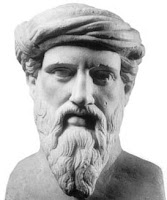
Maybe Pythagoras himself invented the postprandial song: sitting down to his straight edge veg*n meal. In deep musical meditation, lured into song by the rhythmic mastication of his disciples, he begins to hum the blessèd diapason.
People in the 40’s used to laugh in major keys. Man’s guffaws and woman’s’ cackles were tuned to each other―an octave apart―and the glee of their sons and daughters lol’d like a pop choir. But those were jazzier times then, when it was okay for boys to laugh like birds, and girls to cry like dolphins. People didn’t just eat their words in those days, but full sentences as well, and whole songs too.
One such song from the Golden Age of Joke Songs with cow-bell-slinging kazoo-toting Spike Jones and nice-and-keen shaven Benny Bell, is the Woody Wood Pecker Theme that features Mel Blanc’s major laugh melody below.
The laugh is an F# Major chord in Second Inversion meaning the root is transposed to the 5th, the C# in this case. The whole thing ends with a series of triplets on the major 3rd, the A#. Though the melody is in F#, it only hits the root in passing in the rising triplets.
The Woody Woodpecker laugh sounds suspiciously like the “Charge Melody” played at Basketball games. They are both Second Inversion Major chords, played in the same arpeggiated manner. Did the Woody laugh melody inspire the early NBA organists to quote the well-known leitmotif in their charges?
This site was constructed with Flash widgets which looked really cool, but then Adobe killed Flash and now parts of this page don't work. Nevertheless, Zombie Los Doggies Dot Com continues to walk the Earth.
RSS
Subscribe to our RSS feed and get 1-2 posts a week about life and music.


 Real men know how to end a song. They don’t play chicken at the chorus, so why wimp out in the final bars? Real men kill their songs with their bare hands, like babies crying in their cribs far past bed time. Songs are the sons of men—prodigal, oedipal—and they’ll kill their composer daddies unless he kills them first. Real men hit it, then quit it, but they ain’t no quitters.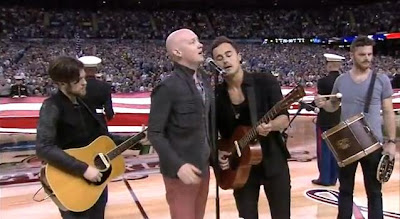
 New York New Yorkers have been singing lots of fresh new songs over the past couple of months. They sing on the street, and in the park, and on the bridge. They even engage in what George Orwell once called “group-sing”. They sing syncopated 4/4 call-and-answer crowd-pleasers, sung with the People’s Microphone, at plus 120 beats per minute, many of them throwbacks to the 60’s anti-war folk era. That old standby “Hey Hey, Ho Ho”, while explicitly unsung throughout the movement, inspires many of the cadences you hear in modern day protest music. “The People United” as widgetized below, has the same feel as this revolutionary classic. To sing it is to realize a tambourine is never far behind.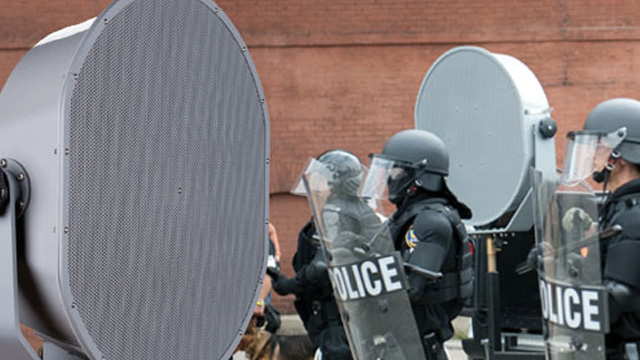
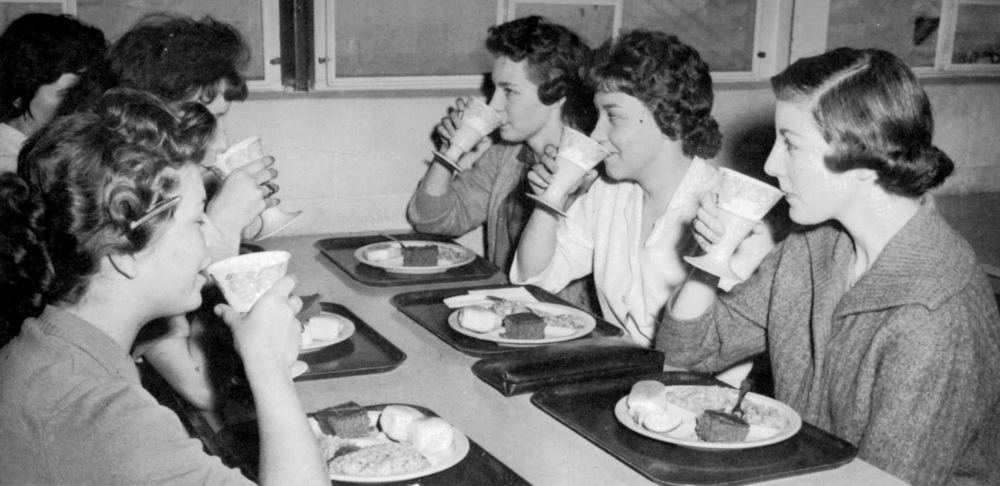
 The postprandial song consists of octaves―octaves that make you go mmmm. It’s a funky ass groove too, alternating octaves with portamento bends going up and down. This is known as a ‘murky bass’ or ‘broken octaves’. The example above is near an F# octave. The high F#‘s bend up, while the low F#‘s bend down. The final tone actually bends a little lower than the second tone, because of the singer’s sustained gastronomic delight.
 People in the 40’s used to laugh in major keys. Man’s guffaws and woman’s’ cackles were tuned to each other―an octave apart―and the glee of their sons and daughters lol’d like a pop choir. But those were jazzier times then, when it was okay for boys to laugh like birds, and girls to cry like dolphins. People didn’t just eat their words in those days, but full sentences as well, and whole songs too.