In this artsy vid, Jelly Stormcloud drives down to Long Island and assaults Jones Beach.
New Song for an Old Friend
We released a new song called “Across the Kill” in honor of Ludwig Day, a townwide celebration in New Paltz.

Ludwig used to open for us. If you attended a Los show from ’09–11, you were guaranteed a Ludwig opener; it was the cherry on the front of the cake. He was playing most weekday nights on the Karaoke circuit for decades, so it wasn’t exactly a unique thing, and I’m not really sure how the details were negotiated. I believe he just showed up one day, ready to open, as if he walked off the pages of our local folklore. Like most folks, we became friends with Mr. Montesa on Main Street, after seeing this fabulous specimen careening quaquaversally upon high heels, handbag over his shoulder, and a measurable amount of sass in his pants. He used to visit me at Earthgoods multiple times throughout the day, and show me manuscripts of the local choir he sang for. The song was always “Oh Shenandoah”, a word that I can’t bring myself to pronounce. It was this mighty word, a mellifluous meme, referencing an entirely different river, that ultimately carries the blame for this song’s birthing.
I heard a story at Ludwig’s funeral, about how he used to sneak out of his room every night, out on the roof of Gourmet Pizza, after his parents went to sleep. Even if it’s not true, I like thinking they had no idea they were living with an absolute Karaoke legend. So I dedicate this to you, my sweet boy, my Shenandoherty, my Gloria.
“Across the Kill” is available free for stream and download.
Delano Park

NEWS RELEASE: Los Doggies Releases Free Mix Tape Inspired by Friends and Family
NEW PALTZ, NY (May 8th, 2015) – Los Doggies releases “Delano Park,” a mix tape of new songs written for friends and family. Each of the five songs is dedicated to a specific person intimately connected to the band as reward for a successful Kickstarter campaign.
Drummer Evan Stormo says he prefers the short form of a mix tape, calling it a “rocking, yet easy one-sit listen of Side A songs concerned with homesickness.” Mr. Stormo further stresses it is “something the whole family can enjoy, no matter how dysfunctional.”
“Delano Park” opens with the faux Ben-Folds swinger, “Why Am I So Fat?” followed by the sultry Halloween classic “Scary Love”, giving way to the Beatles-esque title track, then treading old ground in the meta-musical “For Elyse” with hat tip to John Lovitz, and finally closing on the Frenchified dancehall ballad “The Long Island Sea.”
“Delano Park” is available for free download at Bandcamp.
About Los Doggies
The Stormo brothers formed Los Doggies in the late ‘90s while writing jingles for their answering machine. In the early ’00s, they adopted a bassist named subPixel. They now make music as a trio in the mountain valley town of New Paltz, New York.
Contact
Tim Hanks, Media Relations
timhanks@losdoggies.com
Drum Beat Song
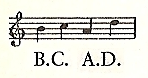
What happens when you accidentally give your drum charts to the keyboardist? You end up with the Drum Beat Song. Click on the score to play/stop.
The Drum Beat Song is a standard 4/4 Rock Beat at 120 bpm set to music. Using drum notation, the kick drum translates to a low D, while the snare drum is a Middle C, and the hi-hat up top is a high G. Together, they form an incomplete D7(sus4). Drag over the chord below. Use the drum beat beat above and the drum beat chord below for an ultimate drum beat jam. Why not tap along at home using the membranophones on your own body?
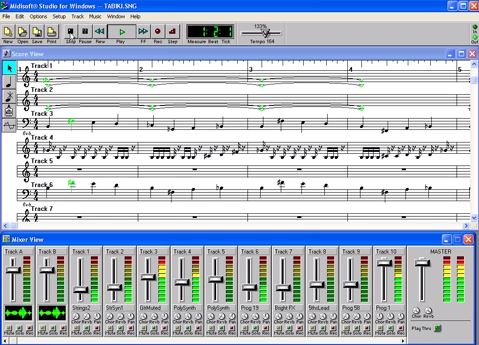 How and when did the Drum Beat Song arise? Well, some centuries ago, a pianist in an orchestra accidentally got the timpani parts, and the theater was treated to a fantastic musical joke. Later on, there was this Jazz band that mixed up its score sheets, and again the pianist got the drum parts, now swinging ting ting ting-ting like Jazz cymbals, and dropping dominant seventh bombs on the bass. Then after that, there was an electronic musician with a live MIDI trigger that he forgot to set to the drum channel; the audience laughed their faces off when they heard sine waves blooping a familiar beat.
I first came across the Drum Beat Song using Midisoft 4.0—the greatest program ever made in 1994. If you forgot to set your drum channels properly, this beat, or another beat just like it, would hilariously play on the default piano, sometimes creating for a novel sound of unsuspecting beauty. Is this merely a conceptual art excercise? Or can the Drum Beat Song find its way into real music someday?
Have you encountered the Drum Beat Song before? Please share your stories in the comments section.
Snake Charmer
The ‘Snake Charmer’ is a popular melody for evoking the Middle East. Here it is in the key of E minor.
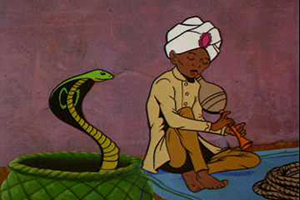 The Snake Charmer melody comes from a song called “The Streets of Cairo” written by showman and congressman Sol Bloom. Bloom was the entertainment director of the Chicago World’s Columbian Exposition of 1893, and improvised the tune based on an old folk melody. Ever since, the first twelve notes have been used in countless songs, cartoons, and on the streets and in the schools, as a shorthand for snake charmers and camel rides, right up there with the Oriental Riff and the cowboy’s Jew’s harp, that forms the foundations of our limited enthnomusic vocabulary.
The Snake Charmer heralded the age of belly-dancing for a tightly-corseted populace, and popularized a scandalous dance craze known as the “kutchy kutchy”. The version I first encountered in Elementary School was a variation of the Dr. Demento parody involving naked French ladies. The original lyrics could very well be a parody itself, with a “poor little maid” who puts “all the dudes in a flurry.”
Click on the score to play/stop and drag over the chords.
As a child, this song led me to believe France was an exotic place of cheap French whores and glory holes in the walls, and I knew that I must go there, no matter what the costs, I would be a weeaboo for France, l’ouiabeaux, for France—always France!
The playground version probably didn’t jump up a fourth like that, but it serves as a nice hat tip to the original, and displays a kind of folk simplicity we value here at snakes dot com.
So to sum up, a century-old joke song about loose foreign women was imported from Eastern lands via France to the New World, where it became a cartoon cliché, disneyfied and eroticized by the savage American public.
Hey Snakecharmer, don’t mothers make good fathers?
Snakecharmer!
Sonic Melodies
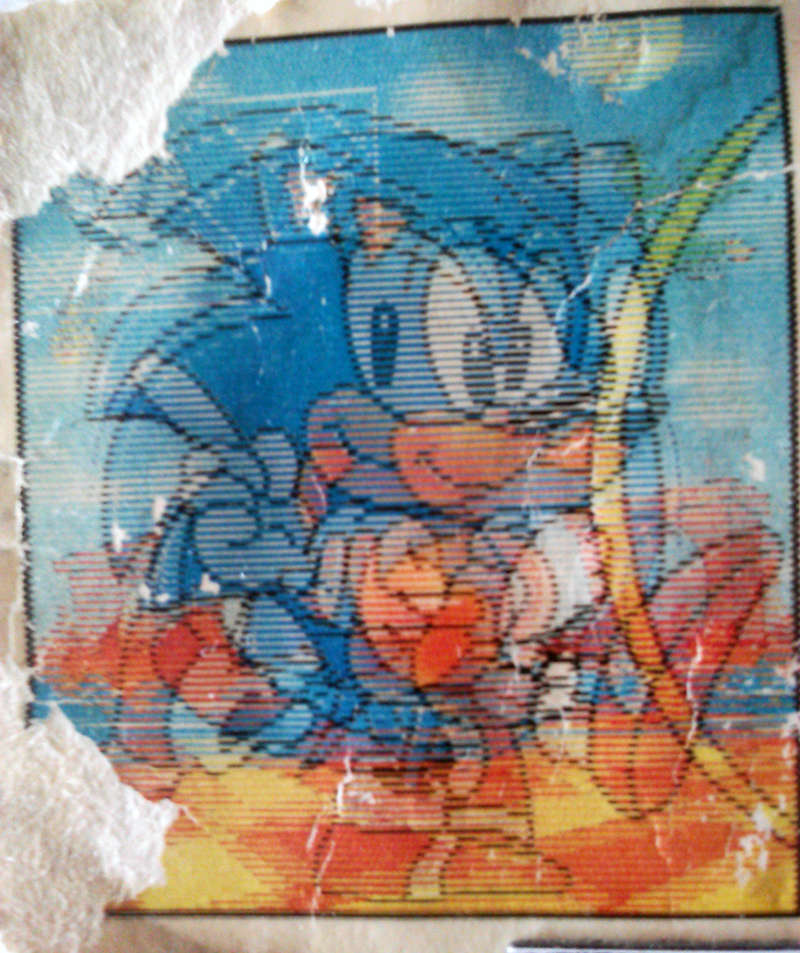
The ‘Continue Sound’ from Sonic the Hedgehog is a series of arpeggios ascending and decrescendoing.
 The arpeggios make up the first five chords of the C Major scale—C major, D minor, E minor, F major, and G major, just like “Doe, a Dear”. It has a pedagogical quality, though it is very musical, like this blog. An extended version of the Continue sound found its way into the Los Doggies song “Major Minor Minor Major”.
Arpeggios were a necessary part of the early Nintendo sound card, limited to just 3 voices for melody and harmony, and a noise channel for rhythm. This shaped the horizontal sound of gaming’s Golden Age, and established the need for arpeggios in order to express complex chords. There was also a strong Prog-Rock and Metal influence on the Japanese composers. Sega soundtracks were even more metal, with its 16-bit Arcade timbres, and overall rebellious teen attitude, ready to dethrone Mario as King of Vidya.
Masato Nakamura, composer of Sonic 1 & 2, faced the same sound card limitations of 3 voices and a noise channel, as well as the inherent groove of the game, what distinguishes the blue hedgehog from the Italian plumber—Speed! That means quick tempos all around, with heavy back-beats, and driving rhythm. “Green Hill Zone” serves as but one example of the hi-paced Pop masterpiece that is Sonic 1. Mario could only approach that speed with time running out on the clock.
Let’s hear what Nakamura-san has to say.
“I wanted ‘Sonic’ to come across as cinematic.
I wanted melodies that the player would hum along with as they were playing, dramatic music for when the scenes were intense, climactic music for when bosses would show up, and then tie it all together with an uplifting theme for the end credits. That was what I knew I wanted it all to be like.
Nowadays, RPG’s use this sort of musical technique a lot, but at the time, action games like ‘Sonic’ didn’t.
And so, from watching movies, I composed melodies that kept the game tempo in mind without sounding unnatural. I also wanted to make sure that the music didn’t loose its groove. After all, one of Sonic’s key elements lies in speed.”
Like Mario, the classic sounds of Sonic and much of his soundtrack are in the key of C Major. But Koji Kondo of Super Mario Bros. is a far more corny kind of dude than our Nakamura-san. He doesn’t mess around with the samba or the waltz. Let’s just say, it’s clear Mr. Masato is in a band. But would you suspect he’s the bassist?!
“The power that music has is really amazing. I keep saying it, but it always feels really wonderful to hear people humming those tunes.
When I walk by arcades, I’ll hear crane game machines playing ‘Sonic’ music, and I’ll just stop there, and listen, and I’ll cry a little bit from all of the memories.”

Leave your Sonic melody memories below.
Sega Melodies
The famous intro sound of the 16-bit Sega Genesis, which I assume is a choir of Japanese dudes with the most lovely singing voices in the world.
What we have here is an interval of a minor third between two major chords: Eb Major to a C Major sung in parallel harmony. The chords appear in second inversion with the lowest voice singing the fifth. There is a synth bass rounding out the chord by playing the root notes: Eb to C.
The “Se-ga” chant first appeared on TV commercials and was used in the game Sonic The Hedgehog. According to the lead programmer Yuji Naka, the wav file for the sample took up 1/8 of the 4MB cartridge space, and replaced a scrapped animation sequence of Sonic break-dancing. Back in 1991, when you started up this game, and this hi-fi human sound came on, it was like the arcade had finally come home. Machines weren’t just talking, bleepily-bloopily, for now they could sing.
The original radio-style bumper of “Se-ga” was eventually replaced by another earworm, the “Sega Scream”, performed in a duplet of Concert A’s.
It’s hard to decide which is more mimetic and annoying over time—the scream or the song? They’re not really as inoffensive as the satisfying “By Mennen,” the king of commercial earworms.
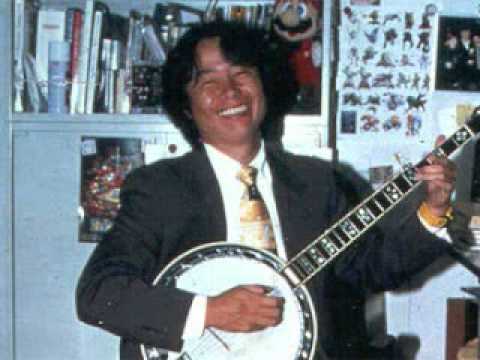
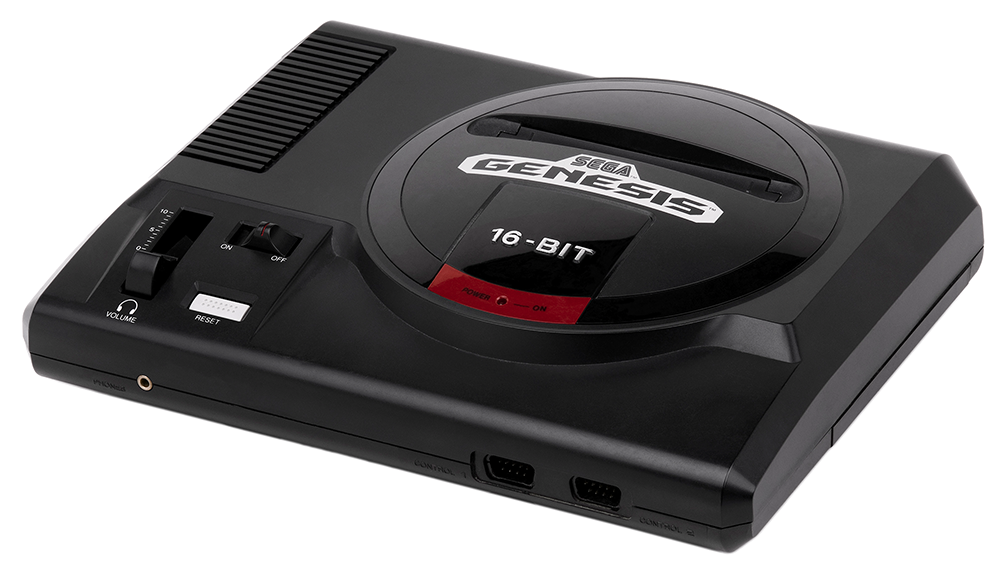 In the past, this blog has almost exclusively focused on the Nintendo Entertainment System, as if it were a case of brand loyalty, but all that’s about to change. We know who has the real swagga: the Swagga Genesis. Sega is death metal to the bubblegum pop of Nintendo. Sega is a rebellious teen (like a new Los song), while Nintendo is a Japanese schoolboy is a nintendog is a pokémon. Sega wears a blue mohawk and plays electric guitar, while Nintendo rides a bicycle to work and plays banjo. Sega is black; Nintendo is asian.
Sega is short for “Service Games.” It’s clean. In Japanese, Nintendo means “work really hard but at the end of the day it is in heaven’s hands,” or some such Jingrish jive. Everyone knows Nintendo is run by the yakuza, but Sega is an Air Force intelligence psy-op; in other words: All-American.