Skip to content

Picardy Party

A picardy is a minor-major switcheroo. When music is sad, and suddenly turns triumphant, this is the picardy at work. And it is all thanks to one little note – the Third or Mediant.

In the example above, the Mediant is the note in the middle – the Third. In C Minor the mediant E Flat, gets sharpened up to an E for a C Major. C Minor picardies to a C Major and it feels goods. To discover why, we turn to the dreaded Harmonic Series!


Consonances are found in the lower harmonics, while dissonances are found in the higher harmonics. You can see a C Major chord forming early on in the first five harmonics (C G C E G). Thus, every pitched note you hear has an implicit Majorness to it, as per the harmonic series.

A picardy used as a musical device not only makes us happy by switching to Major, but because it changes key on the same degree, has an extra triumphant boost. The tonic C overcomes his sad minor self, sharpening his third to an E, and becomes consonant, major, and awesome.

Aye picardies! Radiohead do it, The Beatles did it, J.S.Bach did it so cheesey, but no one do it like Lionel:

“Hello” Picardy by Lionel Richie
It begins on A Minor with a “Hello”, down to G, then F, then picardies up to an A Major for the “looking for!”


Picardy also has plenty of cheeky potential. Take the example from “Roundabout” by Yes, a Minor classic that resolves in a picardied E Major chord.

Very cheeky. Or is it pretentious?


Here’s a cheeky picardy of Beethoven’s “Für Elise” written on the Casiotone mt-46.


This is a highly cheeky picardy because of all the blue notes – those devilish D sharps. It’s downright bebop now. The phrase is the same as the original until the end where it picardies at the C#, which is usually a C natural, and in the key of A Minor, now picardied to A major. Cheer up there Beethoven!

Less common is the “Reverse Picardy” where a Major song turns Minor. It seems that the Harmonic series pushes human music ever and ever Major.

Here’s a version of Pachelbel’s Canon in D Minor – a reversed picardy of its former self. The usual “I V vi iii IV I IV V” is now minored where major and majored where minor, making it “i v VI III vi i iv v”.

Surely this is both sad and pretentious!

The Pink Floyd song A Pillow of Winds is structured “Major-Minor-Major”. It’s a Picardy Trip!

It’s your turn now at home. Can you help think of notable picardies, Major Minor switcheroo’s, and the like? Just write ’em down in the comments section.

While My Guitar Gently Weeps


There’s a kind of swelling of guitars, like violins joyously weeping. Some of them, are possibly reversed. Who can tell? They cyclone around the protagonist’s sorrow, wrapping up the episode’s final moment, when the TV composer twists it all around and drops a heavy Twin Peaks chord on the Stringboard, if only to launch the last of a few too many tasty bends into the fading credited night.

Gone are the days when TV scores were fashioned by a couple dudes sitting at their computers with distorted guitars (Or is that still going on?). Now it’s all ready-made indy pop rock buzz-clips in every commercial.

If only the reptillian broadcasters would bait a Los earworm!

Dwo Durtle Doves

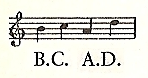
The turtle dove sings around a C♮ and C# in sets of three. Click and drag over each phrase above. Those are trills of 64th notes, or maybe even 128th notes. You can call them “hemdemisemiquavers”. To check his pitch, just click the Rabbit Face on the Color Keyboard up top. That’s a C Natural baby!

His trills sound like “turr, turr, turr”, the onomatopoeia that named him. The first trill bends up from C to C#, and the other two bend down from C# to C. In musical notation, a trill is written like so:

A trill is a rapid alteration of adjacent notes. The turtle dove trills notes within a semitone. Like all birds, he is working at a much quicker musical pace than us. In a single trill, he’ll hit 15 or so notes, but the three phrases essentially follow the “up, down, down” movement as indicated above. Up, down, down, rest. Up, down, down, rest. Isn’t it such a dovey thing to mournfully slide down your final note?

If James Joyce were writing this, he’d pun up like this and call it a day:

Mozart’s Ghost


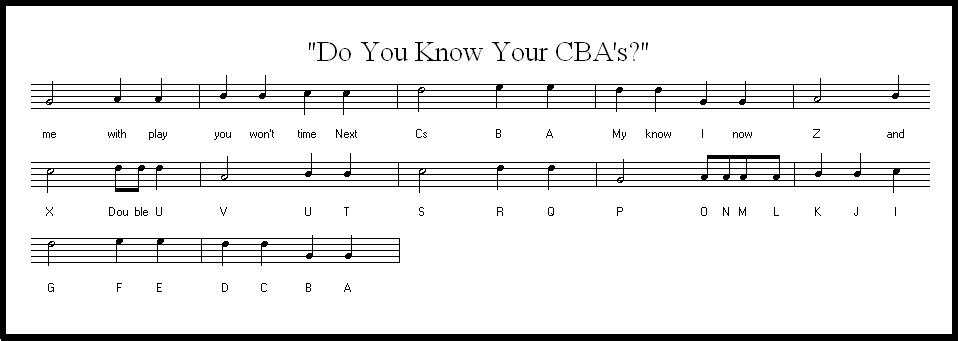
Do You Know Your CBA’s?

KnowyourCBA_medium

Have you ever been on your way to a gig, when the police and their portamento cries pull-over your tour-car, and force your band to perform all manner of hazing rituals and musical games? Musicians and civilians alike are expected to recite things never learned by rote, or learned at all—retrograded songs, inverted childhood concepts—and all the while, maintaining bodily integrity.

Well, hold on there officer, I’ve got a mnemonic device in the glove.

Here’s your ABC’s in reverse. Of course, it may be incriminating if you sing the colloquial sections backwards.

“The Reversed Alphabet Song”

♬ ♬ ♬ “Me, with play you won’t time next, C’s, B A, My know I now. Z ,and Y, X, Double U, V, UTS, RQP, ONMLK, JIHG, FEDCBA.” ♬ ♬ ♬


So when you reverse the above song, you’ll hear the familiar tune to “Twinkle, Twinkle, Little Star”.

“The Reversed Reversed Alphabet Song”


amadeus_l

The “Alphabet Song” and “Twinkle, Twinkle” are all based on the same folk melody written by…get this: Fuckin’ Mozart!

Next time your band gets pulled over, why not subject the cops to a breath test of your own—a “Hold-Your-Breath-The-Longest” Test!

Because of your melodic inversions and lung capacity, I’m letting you boys off with a warning. Rock on. And rock safe.

(And if you couldn’t get enough, here’s the original…)

Bustin’ Makes Me Feel Good

The high B and C on a pianoforte drive the spirits away. Every house should have a baby Steinway, just in case, for bustin’s sake.

Oh, but don’t you go anywhere poltergeists! You can rap upon the walls, bewitch the acoustics and electronics. Add some much-needed white noise. Watch Murray hit this little semitone upside down on the youtube below.

I just love piano humor. Ya know? Like Victor Borge?

Owlisimo

Igor Stravinsky relates the following story in his “Conversations with Robert Craft” (Now with computerized sounds!):

“On a recent visit to Asolo, to see the composer Malipiero, I was strongly reminded of D’Annunzio. Malipiero has a most extraordinary and not entirely un-D’Annunzian house himself, a fine Venetian building on a hillside. One enters under a Latin inscription and plunges into darkest night. The dark is in deference to pairs of owls who, from covered cages in obscure corners, hoot the two notes,

in tune with Malipiero’s piano after he plays them. There is evidence in the garden of affection for other of God’s feathered creatures: chickens have been buried in marked graves; Malipiero’s chickens die of old age.”

Reading this little passage so many years ago, I realized animals can make notes as well. Not just sounds, but music too. Non-human animal music is as glorious as any human, aleatoric, or industrial music.

The breakup of the narrative with a single little score, provided the inspiration for the blog you’re reading now. Notes and text, side by side, like they used to be, when poetry was sung. When Beowulf was a Pop Song.

I’m not sure what kind of owls Malipiero kept on his property, as his personal strigine piano tuners, but they apparently hooted a high Eb and D over and over (Drag over the score above). That’s a semitone interval, the very smallest interval there is.

Think of Igor, entering this strange manor, under moonlight, with the portamento winds blowing, and two bassy owls taunting the poor Russian with their darkling semitones. Not unlike, Kubrick’s Eyes Wide Shut, a completely semitonal score featuring F’s and F#’s.

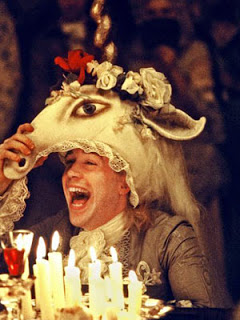
Thank you Stravinsky, you caprine-miened Rusky!