Skip to content

Rock Star Grammar

Rock star grammar is a subject very dear to me, and woe to the Chicago-style Nazis and prescriptive word-wardens, the Creative Writing teachers and literalist listeners; woe to ’em.

Sometimes the demands of the melody outweigh the goal of making sense or even expressing meaning to your audience. Sometimes the song just writes itself, and it don’t got nothing to say; it’s a beautiful nonsensical mess. As a general rule, when lyrics are written to music you get bad poetry, and when poetry is sung you get cheesy music.

Elton John, the Pizza Man himself, never writes any lyrics to his songs, so he probably uses food-related placeholders in the chorus, as well as random refrains of twinkydinks and other jibberjabberwockycocks, the very jive and scribble speech of our dreams, before his lyricist turns “Tony Danza” or “Can You Feed Me Pizza Pies?” into a Grammy win. Mac Culkin geniusly appropriated the raw pizza tracks as art-rock set-pieces.

As legend has it, Paul McCartney dreamt up the song “Yesterday”, and lest he be Kubla Khan’d in his sleep, he hastily recorded a demo version in the middle of the night with the subbed in lyrics “Scrambled Eggs.”

Scrambled Eggs
All my bacon seemed so fried today

We now know that Sir Paul’s bionetic doppleganger-stalker symbiote—Faul McCartney, the even cuter Beatle—wrote the song “Yesterday” the day after he buried Paul.

* * *

Probably the most iconic instance of rock star grammar is found in Meatloaf’s “I’d Do Anything For Love (But I won’t Do That).”

But I’ll never forgive myself if we don’t go all the way tonight
And I would do anything for love, oh I would do anything for love
Oh I would do anything for love, but I won’t do that, no I won’t do that.
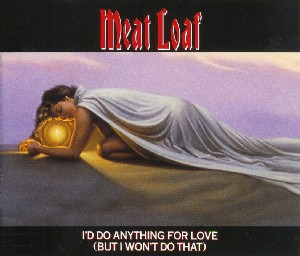
There are a few different readings of this line and all are troublesome. If the “that” is to be interpreted as infidelity, then why does he phrase it with the conjunction “but”, when it doesn’t contrast with his declaration of doing anything for love, and later in the song he directly challenges the accusation of “screwin’ around” with “NO I won’t do that.”

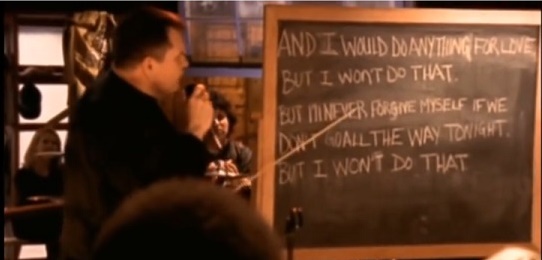
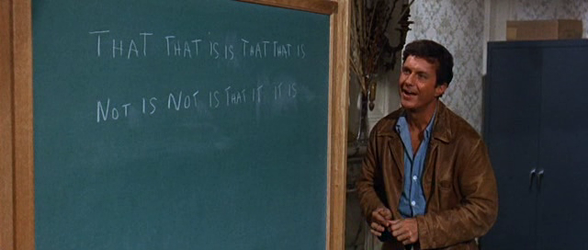
On VH1 Storytellers, Meat used a pointer and chalkboard (with the lyrics backwards as if to befuddle the fans) to explain the “that” in the song is contained in the lyric right before each chorus. That = “I’ll never forgive myself if we don’t go all the way tonight.” However, a literal substitution is problematic.

I would do anything for love, but I won’t never forgive myself if we don’t have sex tonight.


While the song gives many examples of what “that” could be, the lyrics imply it is something Meat would not do for love, while the “thats” of the song are all things that further Meat’s love and deepen his commitment to Mrs. Loaf, except for cheating, which still doesn’t make sense using “but,” when Meat really means “so” as in “SO I won’t do that.” Or “And I won’t do that” works. But “but” sounds better, I guess, which is why the song goes like that. What need have you for proper grammar when you rock star?


The best interpretation of the “that” in the song, as is the case in Sir Elton’s songs, is Sodomic Sex Magick (S&S&M).

* * *

Another irksome example of rock star grammar is found in Snow Patrol’s “Chasing Cars”. The catchy chorus goes “If I lay here / If I just lay here”, which sure sounds good, but the correct inflection should go “If I lie here / If I just lie here.” Sorry brogues.


Likewise, Bobby Dylan’s classic should go: Lie Lady Lie; lie upon my big-ass bed.

* * *

For some reason, I usually don’t hear lyrics in Music, like I don’t speak the language, and that might explain why Los Doggies sings about farts and shit. And to let my plebiness show some more, I don’t really care for poetry either.

But I’ve always like this verse by Austrian painter and Patron Saint of Hebephiles—Egon Schiele.

I am in myself,
the other ones are marked by thirthy longings and
all is for them through me.
They are in theirselves with me.
Because all the otherones I love too.
I love the noble ones in accepting in my heart
by giving back what I received.
I am human loving death and life.

That’s a nice one there and the grammar is neat too, although it might just be a bad translation.

I may not like poetry, but when it comes to bad grammar, I am the fucking Lizard King. And I’ve always liked starting sentences with “ands” and “buts” so I can sympathize with Meatloaf’s buts.

But can you think of more examples of bad grammar that serves a musical purpose? Please share them in the comments section below.

Elec Man, Faithfully

In our last post, we explored the melody of Mega Man’s cooler older brother Proto Man. Today, we’ll look at one of the original Robot Masters: Elec Man.

Elec Man was designed to oversee atomic energy power plants. Like Godzilla, he is a Japanese metaphor for The Bomb. Like other ego-magnetic electro-maniacs, he wears a cool lightning mask. Quick Man may be quicker, and Spark Man may have more volts, but Elec Man’s Theme is more memorable, even if it is just a Journey rip-off.


Full Elec Man Song


Sit with this melody for a moment. Notice the symmetry of the rests and the 4 notes, beginning and ending with D#, framed by a quarter rest.

These 4 notes of the Elec Man Theme are also found in the same rhythm and key in Journey’s “Faithfully”. Nintendo’s Golden Age music was heavily inspired by ’80s New Wave, Metal, and Prog. Both songs from Journey and Elec Man are in B Major, repeat the same simple melody over 8 bars, and follow a similarly descending bassline.

The 4 notes are a popular cliché (3rd, 2nd, 4th, 3rd), and not exactly the same as Journey’s intro piano riff, so we might’ve just chalked this up to a Vanilla Ice kinda scenario, where the subtraction of a single note creates an entirely new song. But wait till the end of “Faithfully”, and Steve Perry sings straight Elec Man in “woahs”; it is undeniable. The bassline is similar in that it descend, while the melody vamps, but it’s slightly different. In Elec Man, we descend from the dominant 7th: I VII IV iv V, or B A E/G# Em/G F#7, while in Journey, it’s a I vi V IV progression: B G#m F# E.

If there ever were a legal battle, the court case would be as epic as a boss battle: Journey vs. Mega Man, and in typical Mega Man series fashion, it could only be settled by the creation of a Steve Perry Robot Master to be included in an alphanumeric sequel.

Can you think of any other songs that use this melody? Please write them in the comments below. Honorary mention to the M.A.S.K. Theme Song.

Proto Man Melody

Proto Man is the cowboy-samurai with a whistle of pure gold. A robo-desperado with the byte motif. He’s also Mega Man’s cooler older brother as is evident by his supercool scarf, sunglasses and shield.
First appearing in Mega Man 3, Proto Man has been the long-time crush of gamer girls and gaymers. He can jump and shoot, but he can’t jump then shoot. Mega Man must power-bust him in the back—his own brother. Drag over the notes of his square flute blues and Proto Man will appear like Candyman.


Full Song

Proto Man’s melody is in G minor pentatonic. He’s too cool for straight pentatonic though, and hits the blue tone D-flat in the third measure. He also bends every important note. It’s so bluesy, they call him “Blues” in Japan.

Anyone who cos-plays as Proto-san at our next gig gets a free backstage sleepover with the band!

Insane Insen

In a recent post, we covered the popular Chinese melody, but what if we want to “turn Japanese” for real? To find out we turn to the Japanese pentatonic Insen scale!

In the example above, the tonic would be on the G#, as it is traditionally written. Generally speaking, and don’t call me a racist, but a 5-note Major Scale tends to sound Chinese, while a 5-note minor scale is totally Japanese. The above sounds like G# minor or D# minor even without a minor third present.

The five notes of the Insen scale represent the five elements: Earth, Water, Fire, Wind and Void. They also have male and female characteristics. It was invented by a blind koto player from Kyoto. So it’s a little too serious for American Pop, but always good for an Oriental song parody, or the occasional post-prog bust-out.

Insen is an incomplete Diatonic scale. It’s a fun key to jam upon, to evoke the exotic Far East. Straight up the scale makes a satisfying melody. Go straight down and you’ve got yourself a song. Use lots of bends on every note for that authentic Kyoto koto sound.

Shift the tonic to E, and you make a neat little Lydian scale (E G# A# C# D#). To hear these five notes in action, listen to “Insane Insen In Six” below. This version from 2010 is much faster than in recent years; it’s insane. From the night of ole Joey’s Cafe.

Top 13 Bloggies for Dummies

Blogs are for dummies. Dumbed down. Bolden and linked. Dck jcks. Fragmentary sentences in broken textspeak. Bloggers on pop sites talking down to you like u’re a t33nagr. It’s the new Tee Vee. And even better: it gives you the illusion of more control when you actually have less. The Net wasn’t designed to enlighten you, but rather to make you its bitch—to use the language of the Netscape.


This here blog is six years young, which is actually quite old in Net time, and probably too esoteric for its own good, though it does rely on the memes of the Net—the colorful jay-pegs and dragable widgets hung on the wall, the cozy youtube player centered on the post, the obscene sarcasm that some would mistake for wit, and all of it lost in the author’s neurosis—a sonic vision more reflective of their own sick desires than a reflection of the world.

Today’s high-speed Net favors lickety-quick, disposable content, both on the surfer end—because we demand instant gratification—as well as by the content creators who dumb everything down for what is believed to be the common denominator—a dummy. Does Hollywood make dumb movies catered to the needs of the international market, or do they set the agenda, knowing that the “useless eaters” (to borrow a Kissinger phrase) in America and China and everywhere in between are so dumb that they’ll eat anything you throw at them? They’re both probably true, and this here author is no better. That ain’t no humblebrag; I’m actually very stupid.

Lo these six years, this blog has had one simple purpose: to inspire musical thought. Whether you’re a composer or listener, musical imagery is a fine thing; along with the smile of a babe and the singing of wine glasses, it’s one the finest things in life.

The Inner Game

As it states in The Inner Game of Kickball, if we’re gonna get good at kickball, we should play with kids who are older and better than us. In this way, we attain mastery. To use the terms of the book, we allow our Self 1 to take a backseat while our Self 2 takes over. Self 1 is your consciousness: the bright vibrating space of your mind. Self 2 is your unconscious: the bottomless pit of your brain, the great abyss of your body. Self 2 is infinitely smarter than Self 1, but Self 2 is only good at sports and playing the violin. Self 1 can write music, listen to music, and tell you it loves you.

When seeking mastery, we must always return to our zen mind beginner’s mind, to the simplicity of our Self 2s. Just as the mind should be polite to the body, the body should seek not to offend the mind. In this way, we become a kind of Self 3 and attain a level of mastery. (Ibid.)

This blog never aims to speak down to you, dear reader, like your some goddamn teenager, but rather to treat you like a friggin’ genius, possessed by little genies, genuinely dreaming and certainly seeming to enjoy your Self 1.

So here’s Los, reminding you to see sharp and be natural.

After the jump:

What do you think; do you like to let your stupid show, let it hang out all over the place, in order to learn and grow and become better than everyone else? Or would you have liked an actual list of thirteen items as promised by the title bait?

Top 13
1.Major Seventhsthe one that started it all.
2.Owlisimo Stravinsky’s inspiration for this blog
3.Crying Codasnothing makes a man cry like a coda
4.Never Jam After Midnight an interesting choice perhaps. but the jam is the tightest on the site.
5.The Bleepthe tone matches the tone. and i do love profanity.
6.Musical Phone Tonesthe strange dissonance of the bitonal telephone and a killer scene from short circuit 2.
7.The Mourning Dove this bird is great and so is Stevie Nicks.
8.Audience Licksa topic that is very dear to me. underrated post.
9.Adult Sing-Alongs in Contemporary Filmanother one that is too serious for words.
10.Bar-Mangled Bannera light-hearted one. and who doesn’t love a good musical boner?
11.American Indian War Chant probably the best widget here. this should be higher up.
12.Sporting Even Melodies let’s face it. music = sports.
13.The Train in Spain Falls Majorly on the Fadea classic widget. classic bloggies.

Coming up next: 11 Ways to Play Music in the Nude

Zelda’s Lullaby

Link from Legend of Zelda is the original warp whistler. He plays the ocarina in Light World and in Dark. Even his shadow plays the ocarina. It’s a fairy ocarina, and Link carries it with him, somewhere on his person, along with bombs, jugs, and silver arrows.

zelda lullaby

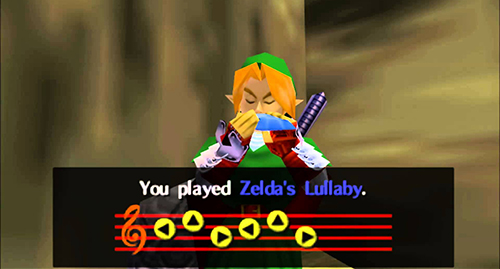
“Zelda’s Lullaby” is a song passed down among the Hyrulean royals and sung to Princess Zelda in her infancy. It can repair broken signs, unlock secret areas, and the Princess loves it. The controller directions pictured above are said to represent the Triforce. The notational shape of the melody also resembles the sacred triangular relic.


Split into three phrases, we begin with three notes that go up then down like a triangle, then played again—another triangle, and the final phrase is a larger triangle that contains the previous two just like a Triforce.

Though the lullaby is in G Major Quadratonic, the tonic G is only played in passing before the final note. Compare this to mogwai song.

“Zelda’s Lullaby” was composed by Jap 6 Jam Champion Koji Kondo. The full version can be heard here.

▲▲

Wolf Whistle

The Wolf Whistle is the way we show our appreciation for the feminine form. And the ladies love it! From construction worker catcalls to cartoon wolves, blown in private or openly with two fingers, the “wheeeet-whooo” is a distinctly sexist melody. Can a melody be racist? Is there Classist Music?

Tex Avery used the Wolf Whistle in his Warner Bros. cartoons, but it originated in the Boatswain’s Call—a navy melody to signal all hands on deck. Fellow sailors repurposed the call in whistle form to signal an attractive woman on land.

Like other casual melodies, the Wolf Whistle follows the natural interval of an Octave (8va). It is similar to the Postprandial Tone, but in reverse. It has a palindromic quality, up an octave, down an octave, at a slow sultry tempo. The mouth Es wide in anticipation, then Os out in release. Though it isn’t inherently sexist, the Wolf Whistle is undeniably sexy.

Sexy as fuck.